Which No-Code Platforms Support FERPA Compliance?
May 27, 2026
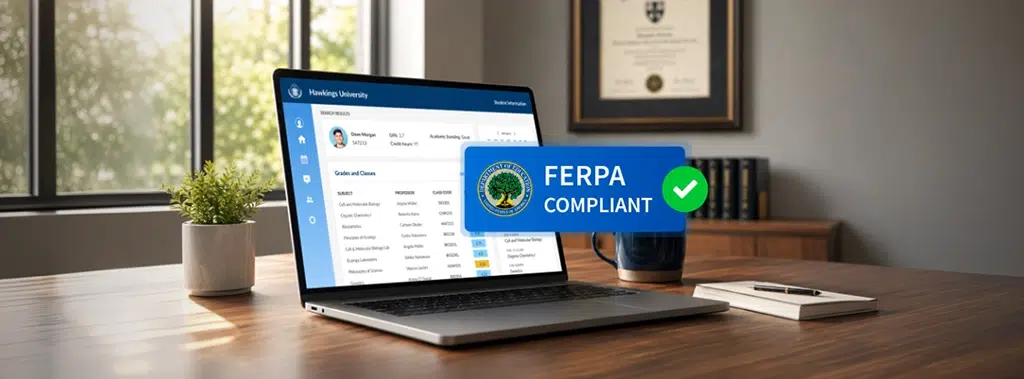
No no-code platform is “FERPA-certified.” FERPA is a federal student privacy law that applies to educational institutions, not a vendor certification program. Schools are the covered entities. The right question is whether a platform gives schools the technical controls and contractual terms they need to support FERPA compliance, including role-based access, audit logging, U.S. data residency, encryption, signed data-handling agreements, and the ability to designate the vendor as a “school official” under 34 CFR Part 99.
Best for: K-12 school districts, higher-education IT teams, charter school networks, and ed-tech vendors that build, host, or process student records, and need a no-code platform that provides the technical and contractual controls schools rely on to meet FERPA.
FERPA, Defined
The Family Educational Rights and Privacy Act of 1974 (FERPA), codified at 20 U.S.C. § 1232g and implemented by 34 CFR Part 99, protects the privacy of student education records. It is enforced by the U.S. Department of Education’s Student Privacy Policy Office (SPPO).
FERPA applies to educational agencies and institutions that receive federal funds under U.S. Department of Education programs. That includes most public K-12 districts, public colleges and universities, and many private institutions that participate in federal student aid programs. The statutory penalty for non-compliance is loss of federal funding. It is rarely invoked, but procurement teams treat FERPA as binding because the institutional risk is severe.
The law gives parents and eligible students, once they turn 18 or attend a postsecondary institution, the right to inspect and review education records, request amendments, and consent to disclosure of personally identifiable information from those records. FERPA tells schools what they must do. It does not create a vendor certification that software companies can earn.
Why “FERPA-Compliant Platform” Is a Misleading Phrase
There is no Department of Education FERPA seal, audit body or vendor certification. Any vendor that puts a “FERPA-certified” badge on its marketing site is overstating what FERPA does.
Keep in mind that the school is the FERPA-covered entity. Vendors are not the primary regulated entity under FERPA. That said, a platform “supports FERPA compliance” by providing technical safeguards, documented security practices, and contractual terms that let the school maintain control over how student data is used, stored, and disclosed.
The mechanism that lets schools share education records with a third-party vendor without prior consent is commonly called the “school official” exception. Under 34 CFR § 99.31(a)(1), a contractor, consultant, volunteer or other third party may qualify only when the party:
- Performs an institutional service or function that the school would otherwise use its own employees to perform;
- Is providing a service or function that has been outsourced by the school;
- Remains under the school’s direct control regarding the use and maintenance of education records;
- Is subject to FERPA’s redisclosure restrictions; and
- Uses the education records only for the authorized purpose.
That contractual triangle – direct control, restricted use, redisclosure limits – is the practical compliance work. A no-code platform that does not let a school sign a data-handling agreement designating the vendor as a school official is not usable for FERPA-sensitive deployments.
The right buyer question, therefore, is not “Is this platform FERPA-compliant?” It is, “Does this platform provide the controls and agreements we need to remain FERPA compliant when we use it?”
What FERPA-Sensitive Software Needs to Support
FERPA itself does not specify software requirements. The Department of Education’s Privacy Technical Assistance Center (PTAC) guidance and state-law overlays (NY § 2-d, CA SOPIPA, IL SOPPA, CT Public Act 16-189) translate FERPA into the operational checklist student data privacy software must satisfy:
- Access control. Restrict education records to authorized school officials with legitimate educational interest. Look for role-based access, record-level security, SSO, and MFA.
- Audit logging. Maintain logs that support investigations into improper access, suspected redisclosure or unauthorized changes.
- Encryption. Look for encryption in transit and at rest for sensitive student data. PTAC guidance and state laws effectively require it.
- U.S. data residency. FERPA does not always require U.S.-only hosting, but many K-12 procurement teams require it in writing.
- Data-handling agreement. Confirm the written agreement designates the vendor as a school official where applicable, restricts redisclosure, limits secondary use and defines data deletion obligations.
- Subprocessor disclosure. Review which infrastructure providers, support contractors and service providers may touch the data.
- Directory-information awareness. 34 CFR § 99.37 permits certain directory information disclosures unless a parent or eligible student opts out. Systems should let schools separate directory information from protected education records.
- Parental access and amendment workflows. Parents and eligible students have the right to inspect, review, and request amendment, so the platform should support secure export, review, and correction workflows.
- Incident response and breach notification. Require written procedures and a contractual obligation to notify the school promptly.
- Independent security attestations. SOC 2 Type II is often requested in procurement. HIPAA matters when school health, counseling, IEP, 504 or special education records overlap with health data requirements.
- State law overlay. New York, California, Illinois, Connecticut, and other states may add student data privacy requirements beyond FERPA.
- Personnel training and accountability. Vendor staff with access to education records must be trained, accountable, and limited in number.
Use this checklist on every no-code platform a district considers for student-facing or student-data work.
How FERPA-Compliant No-Code Platforms Compare
Schools and ed-tech vendors often compare Caspio, Knack, Quickbase, Google AppSheet, and Microsoft Power Apps for student-data applications. All five can support certain education use cases, but they differ in pricing model, deployment options, access-control approach, independent attestations, and how much compliance posture is tied to a broader cloud or enterprise agreement rather than the app platform itself.
Caspio vs. Knack, Quickbase, Google AppSheet, and Microsoft Power Apps, FERPA-relevant capabilities
| Capability | Caspio | Knack | Quickbase | Google AppSheet | Microsoft Power Apps |
|---|---|---|---|---|---|
| U.S. data residency | Yes, US-based data centers | Yes | Yes | Inherited from Google Workspace, not native to AppSheet | Inherited from Microsoft Azure, not native to Power Apps |
| SOC 2 Type II, independently audited annually | Yes, every plan | Higher tiers only | Yes | Inherited from Google Workspace, no AppSheet-specific report | Inherited from Microsoft Cloud, no Power Apps-specific report |
| HIPAA with BAA | Yes, independently certified annually on the separate HIPAA/Compliance plan | Enterprise tier only | Higher tiers only | Workspace-level only, AppSheet itself not separately covered | Available, but only with the right Microsoft licensing stack in place |
| Record-level security | Architectural, enforced at the platform level, not page-by-page | Role-based; users on G2 and Capterra cite limits filtering and grouping pages once an app exceeds about 100 pages | Role-based; reviewers on G2 and Capterra cite confusing access controls and added developer cost to set up correctly | Limited row-level filters, executed row-by-row, which Google’s own docs say degrades performance as data grows | Role-based via Dataverse, governance complexity grows quickly with app count per Microsoft community threads |
| SAML single sign-on | Available on select plans (SAML-in and SAML-out) | Basic SSO on Starter; Advanced SAML SSO as add-on on Pro, included on Corporate and Enterprise | Enterprise tier only | Tied to Workspace identity, not configurable per AppSheet app | Enterprise tier only, often requires premium connector licensing |
| Audit logging | Yes, on every plan | Higher tiers only | Yes | Limited and Workspace-tied | Yes, but spread across multiple admin centers users describe as fragmented |
| “School official” data-handling agreement | Available via standard DPA plus FERPA addendum | Available on Enterprise tier | Available, typically on higher tiers | Folded into the Workspace agreement, not AppSheet-specific | Folded into the Microsoft enterprise agreement, not Power Apps-specific |
| Embed natively on the school’s own domain | Yes, embeddable apps and components | Subdomain or iframe only | Vendor-hosted, no native embed on the school’s domain | Vendor-hosted, no native embed on the school’s domain | Vendor-hosted, no native embed on the school’s domain |
| Pricing model | Flat, unlimited app users on every plan | Tiered by record and app count; users on the Knack community forum and G2 ask repeatedly for storage-based pricing because record caps force plan upgrades | Per-user, with a 20-user platform minimum on the entry plan and a 40-user minimum on the Business plan, raising the real entry point | Per-user, capped at 2,500 rows per AppSheet database on Core plans, which forces enterprise pricing for any sizable dataset | Per-user or per-app; the Per App SKU is no longer sold to new customers as of January 2026, narrowing district options to the more expensive per-user path |
| Starting price | From $300/month, all users included | From $59/month monthly or $49/month annually, capped at 20,000 records and limited app count | From $35/user/month, 20-user platform minimum, real entry around $700/month | From $5/user/month, plus the cost of the Workspace tier needed for compliance | From $5/user/app/month for the legacy SKU, premium connectors and Dataverse capacity priced separately |
| AI capabilities | AI Extension (AI-Powered GPT Connect), Caspio MCP Server, and AI Assistant, all governed inside the platform’s security boundary | Narrow AI features, no MCP server, no in-platform LLM gateway | Narrow AI features, primarily formula and automation assists | Workspace-level AI features that read from Sheets, with the same Sheets sync and row-limit constraints flagged in vendor forums | Microsoft Copilot integration, gated behind additional Copilot licensing on top of Power Apps |
| 24/7 human support | Yes, real people on every plan | Business hours, with users on Trustpilot and G2 citing degraded support response over the last several years | Business hours, tiered, with premium response gated behind higher plans | Tiered, primarily community and ticket-based; Workspace contracts gate live support | Tiered, fragmented across Microsoft 365, Azure, and Power Platform admin centers |
Two structural differences decide most district-scale deployments. The first is pricing model. Quickbase, AppSheet, and Power Apps charge per user. A 5,000-staff district pays by the seat in perpetuity, and costs scale with every new user, every new app, and in the AppSheet case every premium feature.
Caspio’s flat unlimited-app-user pricing removes that variable. The second is the depth of attestation on the plan a district can actually buy. Knack’s SOC 2 and HIPAA coverage concentrates on Enterprise, AppSheet and Power Apps inherit posture from the parent cloud rather than carrying app-specific reports, and Quickbase’s per-user economics push districts to higher plans before the controls they need become available. Caspio carries SOC 2 Type II on every plan, with HIPAA on a separate Compliance plan, both independently certified annually.
How Caspio Supports FERPA Compliance for Schools and Ed-Tech Vendors
Caspio is a low-code/no-code platform that K-12 districts, higher-education IT teams, and ed-tech vendors use to build secure, data-driven applications without writing code. It supports FERPA-aligned deployments, so schools and ed-tech vendors choose it when off-the-shelf tools don’t fit.
It is not a Student Information System (SIS); it is the platform schools use alongside the SIS to build what the SIS doesn’t cover, such as student portals, scholarship intake, reporting dashboards, grant tracking, and case management workflows.
Caspio is not FERPA-certified; no vendor is. What Caspio provides is the technical and contractual stack that makes FERPA compliance achievable for the school:
- Embeddable apps and components on your domain. Deploy enrollment forms, parent portals, student dashboards, scholarship intake, and IEP workflows directly on the school’s existing website. Students, parents, and staff stay inside the institution’s brand and trust boundary.
- Record-level security at the platform level. When a counselor, teacher, or parent logs in, they see only the records they are authorized to see. Permissions are filtered architecturally, not page-by-page. This reduces the risk of unauthorized record exposure caused by page-level configuration errors.
- SAML-in and SAML-out on select plans. Federate to Google Workspace for Education, Microsoft Entra ID, Clever, and ClassLink. Caspio can also act as an identity provider for downstream apps.
- Security and compliance posture. HIPAA and SOC 2 Type II audits run every year by independent third-party auditors. The annual HIPAA certification matters for any school nurse, IEP, 504, behavioral health, or special education record that crosses HIPAA’s domain. See the full compliance posture.
- Audit logging. Audit logging and activity tracking support forensic review and compliance oversight.
- US data residency. Data is hosted in U.S.-based data centers, confirmable in the data-handling agreement.
- Data Processing Agreement and “school official” addendum. Caspio executes DPAs that designate the platform as a school official under 34 CFR § 99.31(a)(1) where applicable, restrict redisclosure, prohibit secondary use, and establish breach notification and data-deletion timelines.
- Unlimited app users on every plan. District-wide rollouts do not trigger per-student or per-user licensing escalations. For any K-12 district or university budget, this is the structural difference between Caspio and the per-user platforms.
- AI capabilities, governed. The AI Extension (AI-Powered GPT Connect) brings AI inside the platform’s security boundary. The Caspio MCP Server lets staff query data with AI assistants like Claude and ChatGPT in natural language, without exporting student records to third-party LLMs. The AI Assistant accelerates app building from plain-language descriptions.
- Integrations. REST API, webhooks, Zapier, Make, n8n, and Keragon (for school-health and IEP workflows) connect Caspio to the SIS, LMS, payment processor, identity provider, and reporting systems schools already use.
- 24/7 human support from real people, not chatbots.
- Pricing starting at $300 per month. Team $300/month covers unlimited app users on every plan; Business $600/month adds capacity; Enterprise is custom; the HIPAA/Compliance add-on starts at $500/month on top of Team or higher (1-year term) for districts with school health or IEP data in scope. Annual billing adds another 10% savings. Caspio also offers a 10% nonprofit discount. 14-day free trial; no free plan.
What Schools and Ed-Tech Vendors Build on Caspio
Schools and ed-tech vendors use Caspio to build the FERPA-compliant database applications that live outside the SIS:
- Student information dashboards and ad-hoc reporting
- Parent and student portals
- Enrollment, re-enrollment, and registration forms
- Behavioral intervention and MTSS (Multi-Tiered System of Supports) tracking
- Special education and IEP workflows
- Attendance, tardiness, and discipline tracking
- Scholarship and financial aid intake
- Greek life, club, and student organization rosters (higher ed)
- Alumni and donor databases
- Faculty advising and degree audit
- Title IX intake and case management
- District grant tracking and federal reporting
How to Evaluate a No-Code Platform for FERPA-Sensitive Work
When scoring no-code platforms for student-data work, run this checklist:
- Ask for the most recent SOC 2 Type II report. If the vendor cannot produce one for the plan tier you are buying, stop there.
- Verify HIPAA posture and BAA availability if school health, nurse, IEP, 504, or counselor records are in scope.
- Confirm U.S. data residency in writing.
- Request the data-handling agreement template. Confirm it designates the vendor as a school official under 34 CFR § 99.31(a)(1), restricts redisclosure, prohibits secondary use, and includes breach notification and data-deletion terms.
- Verify SAML SSO availability on the plan tier you intend to buy, not on a higher tier the sales team is upselling.
- Confirm record-level security is enforced architecturally, not page-by-page.
- Confirm audit logs are exportable.
- Examine the pricing model. Per-student or per-user pricing is fatal for district-scale deployments.
- Request the subprocessor list.
- Ask whether the vendor has worked under your state-specific privacy law and can execute the required addenda.
Frequently Asked Questions
What is FERPA?
FERPA is the Family Educational Rights and Privacy Act of 1974, the federal law that protects the privacy of student education records. Codified at 20 U.S.C. § 1232g and implemented by 34 CFR Part 99, it is enforced by the U.S. Department of Education’s Student Privacy Policy Office. It gives parents, and eligible students 18 or older, the right to inspect, review, request amendment of, and consent to most disclosures of education records.
Are no-code platforms FERPA-compliant?
The phrase “FERPA-compliant” applied to a software vendor is misleading. FERPA regulates schools, not vendors. A no-code platform supports a school’s FERPA compliance by providing access controls, record-level security, audit logging, US data residency, encryption, and a signed data-handling agreement that designates the vendor as a “school official” under 34 CFR § 99.31(a)(1). Caspio, Knack, Quickbase, Google AppSheet, and Microsoft Power Apps each cover some of these controls. The real question is which of them delivers all of the controls a district needs on the plan tier and price point the district can actually buy.
Is Knack FERPA-compliant?
Knack supports FERPA-aligned use cases but cannot claim FERPA certification, because no such certification exists. Knack’s SOC 2 attestation and HIPAA BAA are gated to higher tiers, and SAML SSO sits on Enterprise. Knack’s pricing scales by record count and app count rather than users, which sounds attractive but pushes districts into higher tiers as student data grows; users on the Knack community forum have asked repeatedly for storage-based pricing instead. Some users on review platforms also flag periodic platform slowdowns, support response decline, and limits filtering pages once an app exceeds about 100 pages.
Is Quickbase FERPA-compliant?
Quickbase supports FERPA-aligned use cases. It carries SOC 2 Type II and offers HIPAA with a BAA, with role-based access, audit logging, and SAML on the higher tiers. The structural barrier for districts is per-user pricing combined with platform user minimums (20 users on Team, 40 users on Business), which sets a real entry point well above the per-user sticker. Some users on review platforms also describe the interface as dated, the learning curve as steeper than the “low-code” label suggests, and access controls as confusing enough to require dedicated developer time.
Is Google AppSheet FERPA-compliant?
AppSheet inherits Google Workspace’s compliance posture rather than carrying its own FERPA-aligned attestations. A school can sign the Workspace agreement to designate Google as a school official, but AppSheet-specific controls are thinner. AppSheet is tightly coupled to Google Sheets, and its row-by-row security filters degrade performance as data grows. Google’s own documentation warns about sync slowdowns past a few thousand rows, and the AppSheet community forums show recurring threads on intermittent sync failures, timeouts, and tight database row caps on Core plans. Migrating off AppSheet means rebuilding the app from scratch, which adds switching cost on top of the per-user pricing.
Can a vendor be “FERPA-certified”?
No. The U.S. Department of Education does not certify, accredit, audit, or “FERPA-approve” software products. There is no FERPA audit body and no FERPA seal. The legitimate posture is “supports FERPA compliance” or “provides FERPA-aligned controls”, paired with a signed data-handling agreement that designates the vendor as a school official under 34 CFR § 99.31(a)(1).
What is a “school official” under FERPA, and can a software vendor qualify?
A “school official with legitimate educational interest” is the FERPA exception that lets schools share education records with third parties without parental consent. Under 34 CFR § 99.31(a)(1), a vendor qualifies only if the school designates it in writing, the vendor performs a service the school would otherwise perform itself, the vendor is under the school’s direct control regarding the records, and the vendor is subject to FERPA’s redisclosure restrictions. This designation lives in the data-handling agreement.
What student data is protected under FERPA?
FERPA protects “education records,” or records directly related to a student and maintained by the school or a party acting for it. That includes grades, transcripts, attendance, disciplinary records, IEPs, 504 plans, financial aid records, advising notes, and any digital record tied to a named student. “Directory information”, name, photo, dates of attendance, degrees, awards, can be disclosed without consent unless the parent or eligible student opts out. Schools must support that distinction in their data systems.
Get Started
Caspio supports FERPA-aligned application development for student information dashboards, parent and student portals, scholarship intake, IEP workflows, and other applications that sit alongside the SIS. Schools can pair record-level security, identity management, audit and activity tracking, U.S.-based hosting, unlimited app users, and data-handling terms to support student-data privacy requirements.
Start a 14-day free trial, no credit card required, or see pricing. Districts with school health, IEP, or behavioral records in scope should ask Caspio about the separate HIPAA/Compliance plan and the data-handling agreement that designates Caspio as a school official under 34 CFR § 99.31(a)(1).
Recommended Articles

Top Blaze.tech Alternatives for Business Apps in 2026
READ STORY
Custom Customer Portal Software for Growing Businesses
READ STORY
Best MS Access Alternatives in 2026
READ STORY
Introducing AI Solutions in the Caspio Marketplace
READ STORY
Best Quickbase Alternative for No-Code Apps in 2026
READ STORY
10 Must-Have Features Every Custom CRM Should Include
READ STORY
Modern Employee Portal Software for Enterprise
READ STORY
How to Build a Member Portal Using Low Code
READ STORY
Best Zoho Creator Alternative Without Per-User Pricing
READ STORY
HIPAA Database Software: How to Choose a Compliant Platform
READ STORY
Enterprise Features at Mid-Market Prices: How Low-Code Changed the Game
READ STORY
Caspio vs. Airtable: Which No-Code Platform Is Right for Your Business?
READ STORY
