May 11, 2026
Employee Portal Software for HR and Operations Teams
May 11, 2026

Employee portal software is a secure, internal web application where employees log in with corporate credentials to access HR services, IT requests, company documents and role-based dashboards in one place. The best employee portals unify PTO, benefits, onboarding, expenses, and policy acknowledgements across HR, IT, and operations, without per-seat licensing fees or rigid templates.
Best for: HR and operations leaders at mid-to-large organizations (300+ employees) that need a unified, identity-integrated employee portal for HR workflows, IT requests, and self-service, with SSO/SAML, record-level security, and no per-seat fees.
Instead of relying on disconnected tools, shared drives and multiple logins, organizations are consolidating employee workflows into a single, secure environment. For teams with growing or distributed workforces, this shift improves consistency, visibility and control across departments.
What Is Employee Portal Software?
An employee portal is a secure internal application where employees log in using corporate credentials to access services, information and workflows related to their role.
It acts as a unified layer connecting systems such as HRIS, IT service management, payroll, document storage and communication tools. Employees interact with a single interface, while data and processes remain connected behind the scenes.
Common capabilities include:
- HR self-service, including PTO, benefits, pay stubs, tax forms and personal information
- Onboarding and offboarding workflows with task checklists, document signing, and equipment and access provisioning
- IT and operations requests, such as access provisioning, equipment and facilities
- Document and policy management with acknowledgement tracking
- Employee directories and organizational structure visibility
- Training and certification tracking with expiration alerts
- Performance reviews and workflows to tackle goals and feedback
- Internal communications targeted by department, location or role
- Role-based dashboards for employees, managers and executives
Who uses an employee portal? These portals are typically used by mid-to-large enterprises (300–10,000+ employees), distributed and hybrid workforces, multi-office organizations, deskless-heavy businesses, and regulated industries where HR records, training, and policy acknowledgements must be audit-ready. Industries such as healthcare, finance, education and government often rely on these systems to maintain accurate records and audit readiness.
It’s also helpful to distinguish between an intranet and an employee portal. An intranet is a content destination, primarily storing news, documents and announcements. An employee portal focuses on workflows: requests, approvals, self-service. The best platforms do both, under one identity.
Where Generic, Off-the-Shelf Tools Fall Short
Most organizations don’t start with a dedicated employee portal. Instead, they piece together systems over time: SharePoint, HRIS portals, ticketing tools and shared drives. This approach works initially, but limitations become more visible as complexity increases.
SharePoint is a collaboration platform with customization built on top. Microsoft 365 bundles it, which makes it the path of least resistance for most companies. Fair enough. The catch: anything past a simple workflow becomes a development project. Moderate customization runs $15,000 to $40,000. Enterprise builds push past $100,000, plus 15% to 25% of that in annual maintenance. IT backlogs swell. HR waits months for a form change.
Intranet-in-a-box platforms shape your processes around their model. Simpplr, Staffbase, Workvivo, LumApps, Jostle and Happeo are strong on employee communication, social feeds and news targeting. They are less strong when the workflow you need isn’t one their data model contemplates. You end up fitting the company to the software, not the other way around.
Per-employee SaaS pricing compounds at scale. Most intranet vendors charge per user per month. Entry-tier pricing runs $4 to $12 per user, and enterprise contracts carry five-figure annual minimums that scale with headcount. At 1,000 employees, budgets typically land between $50,000 and $150,000 a year.
HR systems have portals, but each one is single-purpose. Workday, BambooHR, ADP and Paycom each include a self-service portal strong for their core data. None of them is the system of record for IT tickets, expense approval or operations workflows. The result: employees end up with multiple portals and no unified experience.
No-code tools without enterprise security don’t make it through procurement. SAML/SSO, record-level security, directory sync, audit trails, and HIPAA or SOC 2 certification are prerequisites, not optional add-ons.
These limitations often lead organizations to look for a more unified and flexible approach.
What a Modern Employee Portal Requires
A modern employee portal should support both day-to-day operations and long-term growth. Beyond basic functionality, organizations are looking for systems that can adapt to their structure and workflows.
Key considerations include:
- SSO/SAML against your existing IdP (Azure AD/Entra ID, Okta, OneLogin, Ping, Google Workspace) with directory sync for provisioning and deprovisioning
- Record-level security so every employee only accesses their own data, while managers see their direct reports, enforced by the platform, not view configuration
- Role-based dashboards tailored to different teams and responsibilities
- Flexibility to support workflows across HR, IT and operations
- HR workflows: PTO, benefits, onboarding, offboarding, performance reviews, policy acknowledgements, document signing
- Document management with e-signature integration
- Mobile-responsive experience for deskless, frontline, and field employees
- API integrations to your HRIS, ITSM, payroll, finance, and communication tools
- Audit trails with user, timestamp and prior value for every data change
- Unlimited users so every new hire does not trigger a budget review
Rather than relying on predefined modules, many organizations are prioritizing platforms that can support a wider range of processes within a single system.
An employee portal is really one instance of a broader need: custom internal tools that consolidate the workflows your teams currently run across spreadsheets, tickets, and disconnected SaaS. The same requirements — SSO, record-level security, unlimited users — apply whether you’re building for HR, IT, or operations.
Build Modern Employee Portals Using Caspio
Caspio provides a platform for building custom employee portals that bring together workflows across departments.
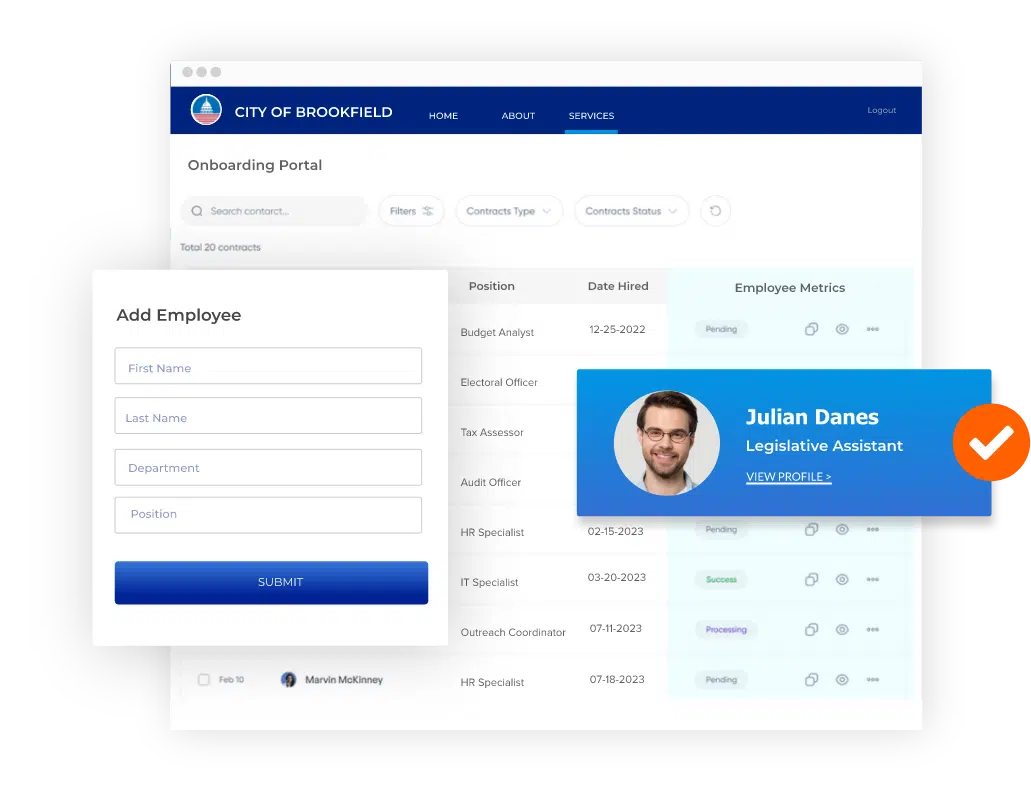
Instead of a fixed intranet or HR portal, it allows organizations to create an application tailored to how their teams operate.
- Built for existing environments. Deploy the portal on your internal domain or intranet shell. Employees interact with it inside your brand and navigation, no handoff to a third-party subdomain.
- Record-level security, built in. Caspio enforces data isolation at the platform level. When an employee logs in, they see only their own records across every table, view and dashboard. A manager sees their team. This approach supports both privacy and operational control.
- Support for multiple departments. Build separate experiences for HR, IT, Finance, Ops and Executive on the same platform, against the same underlying data. Each department can have its own dashboards and processes while sharing a common data structure.
- Unlimited users on every plan. Caspio does not charge per user. At a conservative $8-per-user intranet rate, 500 employees runs $48,000 a year, 1,000 runs $96,000, and 5,000 runs $480,000. Caspio’s Team plan starts at $300 a month and stays flat. The ROI math for scaling organizations writes itself.
- White-labeling on your internal domain. Your brand, your logo, your URL. No third-party branding visible to employees.
- HIPAA and SOC 2 Type II independently certified annually. For healthcare, finance, education and government, the compliance posture is audit-ready. Caspio also supports FERPA for higher education and WCAG accessibility standards.
- SAML-based enterprise SSO. The platform supports SAML-based authentication with identity providers such as Azure AD/Entra ID, Okta and others. Directory sync and automated provisioning can also be supported, depending on configuration.
- AI built into the platform. Caspio’s AI-Powered GPT Connect extension summarizes policy documents, categorizes IT tickets, and runs sentiment analysis on internal surveys. The Caspio MCP Server lets HR and IT query portal data through AI assistants like Claude and ChatGPT. The AI Assistant accelerates development by generating database structures from plain-language prompts.
- Integrations. Caspio connects with existing systems through REST APIs, webhooks and platforms like Zapier, Make and n8n. For healthcare, Caspio integrates with Keragon for HIPAA-compliant automation across 300+ healthcare tools.
- 24/7 human support. Caspio Support is available around the clock for technical guidance and troubleshooting, with Professional Services and partner resources on hand for more complex implementations.
- Pricing from $300/month with a 14-day free trial. No free plan. No per-user fees. No per-module gates. See pricing.
- The cross-departmental point. Most competitors are single-surface intranets optimized for communications. Caspio is the workflow foundation underneath: HR runs PTO and onboarding, IT runs ticketing and assets, Ops runs facilities and expense, all sharing one identity and one audit trail.
Employee Portal Software Comparison
How does Caspio stack up against the leading employee portal and intranet platforms? Here is a side-by-side look at the capabilities that matter when your workforce is in the hundreds or tens of thousands.
Caspio vs. SharePoint, Simpplr, Staffbase, and Workvivo
| Feature | Caspio | SharePoint | Simpplr | Staffbase | Workvivo |
|---|---|---|---|---|---|
| Unlimited users | Yes, on every plan | Per-user via Microsoft 365 license | Per-user, quote-based | Per-user, quote-based | Per-user, quote-based |
| Record-level security | Built in at platform level | Item-level permissions (fragile at scale) | Audience targeting (content-level) | Audience targeting (content-level) | Audience targeting (content-level) |
| SSO/SAML | Yes (SAML-in on select plans; SAML-out) | Yes (Entra ID native) | Yes | Yes | Yes |
| HIPAA compliance / BAA availability | Yes, independently certified annually | Microsoft 365 BAA on specific SKUs | Yes, BAA available | Yes, BAA available | Not publicly documented at product level |
| SOC 2 Type II | Yes, independently certified annually | Yes | Yes | Yes | Yes |
| HR + IT + Ops workflows on one platform | Yes, core capability | Requires Power Platform licensing and dev | Limited (communication/content focus) | Limited (communication focus) | Limited (social engagement focus) |
| Multi-department flexibility | Any workflow, any department | Possible with heavy customization | Departmental pages, fixed model | Departmental channels, fixed model | Departmental spaces, fixed model |
| White-label and embed on your domain | Yes, fully embeddable | Custom domain available | Custom domain (hosted) | Custom domain (hosted) | Custom domain (hosted) |
| Audit trails (user, timestamp, prior value) | Yes, platform level | Content-level audit logging | Content audit logging | Content audit logging | Content audit logging |
| Pricing model | Flat, from $300/month | Bundled in Microsoft 365 + customization ($15K–$100K+) | Quote-based, five-figure annual | Quote-based, five-figure annual | Quote-based, five-figure annual |
| AI capabilities | AI-Powered GPT Connect, MCP Server, AI Assistant | Microsoft Copilot (separate license) | Simpplr AI Assistant | Staffbase AI content tools | Workvivo AI summaries (Zoom AI) |
Where Caspio wins. Caspio is the only option that combines unlimited users on every plan, built-in record-level security and true multi-department workflow flexibility, at flat pricing starting from $300/month. SharePoint is the incumbent, but every custom workflow is a development project. Simpplr, Staffbase and Workvivo are strong communication platforms, simpler because they do less. For organizations that need one portal to handle HR, IT and operations workflows with enterprise security, Caspio stands alone.
Customer Story: Lincoln College Builds Internal Employee Systems Across Departments
What does an employee portal look like across an entire organization? Here’s how one education provider built systems to support staff, departments and students in one environment.

Problem
Lincoln College International needed a faster way to build and manage internal applications used by staff across departments. Traditional development required significant time and resources, while IT capacity was limited and focused primarily on supporting student infrastructure rather than internal systems.
Solution
Using Caspio, the team built applications to support day-to-day employee workflows across HR, IT, finance and other departments. Staff use these systems for tasks like managing leave and payroll calculations, handling IT requests and tracking assets. The applications are also used by students and other internal teams, creating a shared environment for managing operations.
Result
Lincoln College created a flexible system that supports thousands of users, including staff and 6,000–7,000 students, without relying on a large development team. Employees now have purpose-built applications to manage their work, while the organization reduced the need for multiple specialized IT roles and improved usability across internal processes.
Frequently Asked Questions
Ready to build a more unified employee portal? Start with these common questions.
What is an employee portal?
An employee portal is a secure, internal web application where employees log in with corporate credentials to access HR services, IT requests, company documents, training and role-specific dashboards in one place. It replaces the scattered mix of HRIS portals, shared drives, SaaS tools and email-based requests most organizations accumulate.
How do I build a custom employee portal?
Build a custom employee portal on a low-code platform like Caspio. Map the core workflows like HR self-service, IT requests, onboarding, document management and directory. Connect to your identity provider via SAML/SSO. Use the visual app builder to construct forms, dashboards and approval workflows. Deploy it as embeddable components on your internal domain. With Caspio, a basic portal goes live in weeks, not months.
Is employee portal software HIPAA-compliant?
Some platforms support HIPAA compliance, while most communication-focused intranets do not publicly document HIPAA certification. Caspio is independently HIPAA-certified annually and offers a dedicated Compliance tier for organizations handling protected health information. If your employee data includes health-plan enrollment, medical leave or workers’ compensation records, HIPAA certification is not optional.
What is the best employee portal software for large teams?
For large teams, the best HR portal software does not punish growth with per-seat pricing, supports SSO and directory sync against your identity provider, enforces record-level security, and handles HR, IT, and operations workflows on one platform. Caspio is purpose-built for this scenario: unlimited users, platform-level record security, HIPAA and SOC 2 Type II certification, and cross-departmental workflow flexibility.
Can I integrate an employee portal with our SSO?
Yes. Any enterprise-grade portal supports SAML SSO against Azure AD/Entra ID, Okta, OneLogin and Google Workspace. Caspio supports both SAML-in (available on select plans) and SAML-out, plus directory sync for automatic provisioning and deprovisioning.
How much does employee portal software cost?
Costs vary dramatically. SharePoint is bundled with Microsoft 365, but customization projects run $15,000 to $100,000+. Simpplr, Staffbase, Workvivo and LumApps use quote-based per-user pricing with five-figure annual minimums, where a 1,000-employee organization typically budgets $50,000 to $150,000 a year. Caspio starts at $300/month with unlimited users and no per-seat fees.
What’s the difference between an intranet and an employee portal?
An intranet is a content destination: news, announcements, documents. An employee portal is a workflow system: requests, approvals, self-service, transactions. Modern intranet portal software combines both. Communication-first intranets excel at content targeting but struggle with custom workflows; workflow-first platforms like Caspio handle transactions and add content features as needed.
Build Your Employee Portal on Caspio
Employee portals play an increasingly important role in how organizations manage internal operations. As systems and workflows grow more complex, having a unified platform becomes essential.
Caspio provides a way to build an employee portal that supports multiple departments, integrates with existing systems and scales without adding per-user costs. And the portal doesn’t have to stop at HR. The same platform powers your other internal tools, from asset tracking to approval workflows, under one identity and one audit trail.
Start a free trial today and explore how a custom employee portal could work for your organization.


Recommended Articles

The Hidden Costs of Free AI App Builders (2026)
READ STORY How to Read Vendor Compliance Claims: 3 Evidence Classes
READ STORY What a BAA Covers (and Doesn't): HIPAA Guide for App Teams
READ STORY How to Build an Online Database App Without Coding
READ STORY HIPAA Compliance for No-Code Applications: A Guide
READ STORY Tips on Migrating from Microsoft Access to Caspio
READ STORY Best No-Code Platforms for Business Applications (2026)
READ STORY Database Design Best Practices: A Practical Guide
READ STORY
Caspio vs. Knack: Which No-Code Platform Scales Better?
READ STORY Microsoft Access Online: How to Move Your Database to the Cloud
READ STORY Best HIPAA-Compliant App Builders in 2026
READ STORY Turn Spreadsheets Into Web Applications
READ STORYSubscribe for More Updates

