September 2, 2026
Secure Alternatives to Vibe Coding for Business Apps (2026)
September 2, 2026

The secure alternative to vibe coding is governed AI app development: building on a platform where AI-generated output inherits certified security controls, roles, record-level security, and audit logs, instead of shipping as a code artifact nobody owns. Independent scans have found thousands of vibe-built apps exposing secrets, PII, and medical records. The failure is architectural, and the fix is too.
This guide covers what vibe coding is, what the security research actually documents, why scanning and patching cannot fix a structural problem, and five approaches that keep the speed of AI building while dropping the exposure.
What Vibe Coding Is
Vibe coding means describing the software you want to an AI code generator and accepting the resulting code largely on trust. The term, coined by AI researcher Andrej Karpathy in early 2025, originally described an exploratory style of programming. It now covers a wave of prompt-to-app tools, including Lovable, Bolt, Replit, Base44, and v0, that let non-developers produce working applications in hours.
Demand is real, and the trajectory is steep. Gartner predicts that by 2028, 40% of new enterprise production software will be created with vibe coding techniques and tools (Gartner, May 2025, as reported by CIO Dive). Note the scope: Gartner’s usage covers AI-assisted development broadly, including professional developers, not only citizen builders.
Nothing in this article argues against AI-assisted building. The speed gains are genuine, and they are why the category exists. The problem is narrower and better documented: what happens when the code these tools emit goes live carrying business data, with no governance layer around it.
The Documented Failure Record
Five independent research efforts, using different methods on different populations, reached the same conclusion in under a year. Every figure below links to its primary source.
Escape.tech: 5,600+ apps scanned, 2,000+ high-impact vulnerabilities
In October 2025, security firm Escape.tech scanned publicly available applications built with Lovable, Base44, Create.xyz, Vibe Studio, and Bolt. From the published methodology: “Our research team analyzed over 5,600 publicly available applications and identified more than 2,000 vulnerabilities, 400+ exposed secrets, and 175 instances of PII.” The PII included medical records, IBANs, phone numbers, and emails. Escape characterized the vulnerabilities as high-impact. These were publicly available apps and live deployments, not lab samples.
Escape sells security scanning, so read it as a vendor study with a published, checkable methodology. It does not stand alone.
Georgia Tech’s Vibe Security Radar: CVEs rising from 6 to 35 in one quarter
Researchers at Georgia Tech’s Systems Software and Security Lab track CVEs attributed to AI coding tools via signatures in the code itself, such as AI co-author tags and bot emails in commits. As reported by Infosecurity Magazine in March 2026, the monthly count rose from 6 in January 2026 to 15 in February to 35 in March, with 74 confirmed CVEs attributed in total at publication.
Because attribution is signature-based, this is a floor, not a census. Radar founder Hanqing Zhao estimates the true count at 5 to 10 times what the lab detects, and adds: “Realistically, even teams that do code review aren’t going to catch everything when half the codebase is machine-generated.”
Red Access: 2,000+ apps exposing sensitive data, no exploitation required
In May 2026, security firm Red Access scanned 380,000 publicly accessible assets (apps, databases, and related infrastructure) built with tools from Lovable, Base44, Replit, and Netlify. Roughly 5,000 looked corporate. More than 2,000 of those held sensitive data reachable at a public URL, often indexed by Google, with no exploitation required. Axios independently verified exposed examples, including a Brazilian bank’s internal financials, a UK health company’s active clinical trials, and a hospital app containing doctor-patient conversation summaries; eWeek’s coverage reports that both Axios and WIRED independently verified the findings.
The root cause was reported as default-public privacy settings as much as flawed generated code. That distinction matters, and it strengthens the argument rather than weakening it: the builders did not know to change the default, and nothing in the tooling was responsible for knowing on their behalf. That is a governance gap, not a prompt-quality gap.
Wiz on Base44: a critical auth bypass despite security badges
In July 2025, Wiz Research disclosed a critical authentication bypass in Base44 affecting what were intended to be private enterprise applications, including apps configured for SSO-only access and used for internal chatbots, knowledge bases, and PII and HR operations. In fairness: Wix, which owns Base44, patched it within 24 hours of disclosure and confirmed no evidence of past abuse. The lesson remains despite those mitigating facts. Base44 advertises SOC 2 Type II and ISO 27001 today, and the same platform still shipped a critical auth bypass on its customers’ apps. Badges on a code generator are not governance of what it generates.
Veracode: secure generation flat at roughly 55%
If model progress were closing the gap, the problem would be temporary. It is not closing. Veracode’s Spring 2026 GenAI Code Security update, a longitudinal benchmark across 150+ LLMs, found security pass rates stuck at approximately 55%, virtually identical to two years prior, even as functional capability improved. Reasoning-focused models did better, reaching 70 to 72%. That bright spot still means roughly 3 in 10 generation tasks introduce a known flaw, which is not a shippable baseline for a business app holding real data.
Felix Brombacher, Senior Director of Product Management at Veracode, put it plainly: “Models have become excellent at writing code that compiles. They’ve failed at writing code that’s safe.”
Why the Failure Is Architectural, Not Incidental
Three structural properties produce the record above, and none of them is fixable with a better prompt or another scanner.
1. The output is a code artifact. A vibe tool’s deliverable is source code: thousands of lines your team now owns, whether or not anyone on the team can read them. Every vulnerability lives in that artifact, and every fix, patch, and audit runs through it. Gartner’s Predicts 2026 report (December 2025) forecasts that prompt-to-app approaches adopted by citizen developers will increase software defects by 2,500% by 2028 (as reported by ArmorCode). Defects at that scale are not a review-queue problem; they are a structural property of generating artifacts faster than anyone can own them.
2. There is no governance layer where the app lives. Roles, record-level permissions, and audit logging are not defaults in generated code; they are features someone must know to ask for, then verify. The Red Access findings are the direct consequence: apps defaulted to public because no platform layer enforced anything else.
3. Nobody owns the output. The tool vendor’s certifications cover the vendor’s own systems, not your app (the Base44 case is the object lesson). The builder often cannot read the code. Security teams frequently do not know the app exists. Deloitte’s 2026 State of AI in the Enterprise finds only one in five companies has a mature model for governing autonomous AI agents. The ownership vacuum is the norm, not the exception.
The contrast is easiest to see side by side. The code-artifact loop: prompt in, code artifact out. Your team owns that code forever. The governed round-trip: prompt in, governed app out. Humans and AI edit the same app.
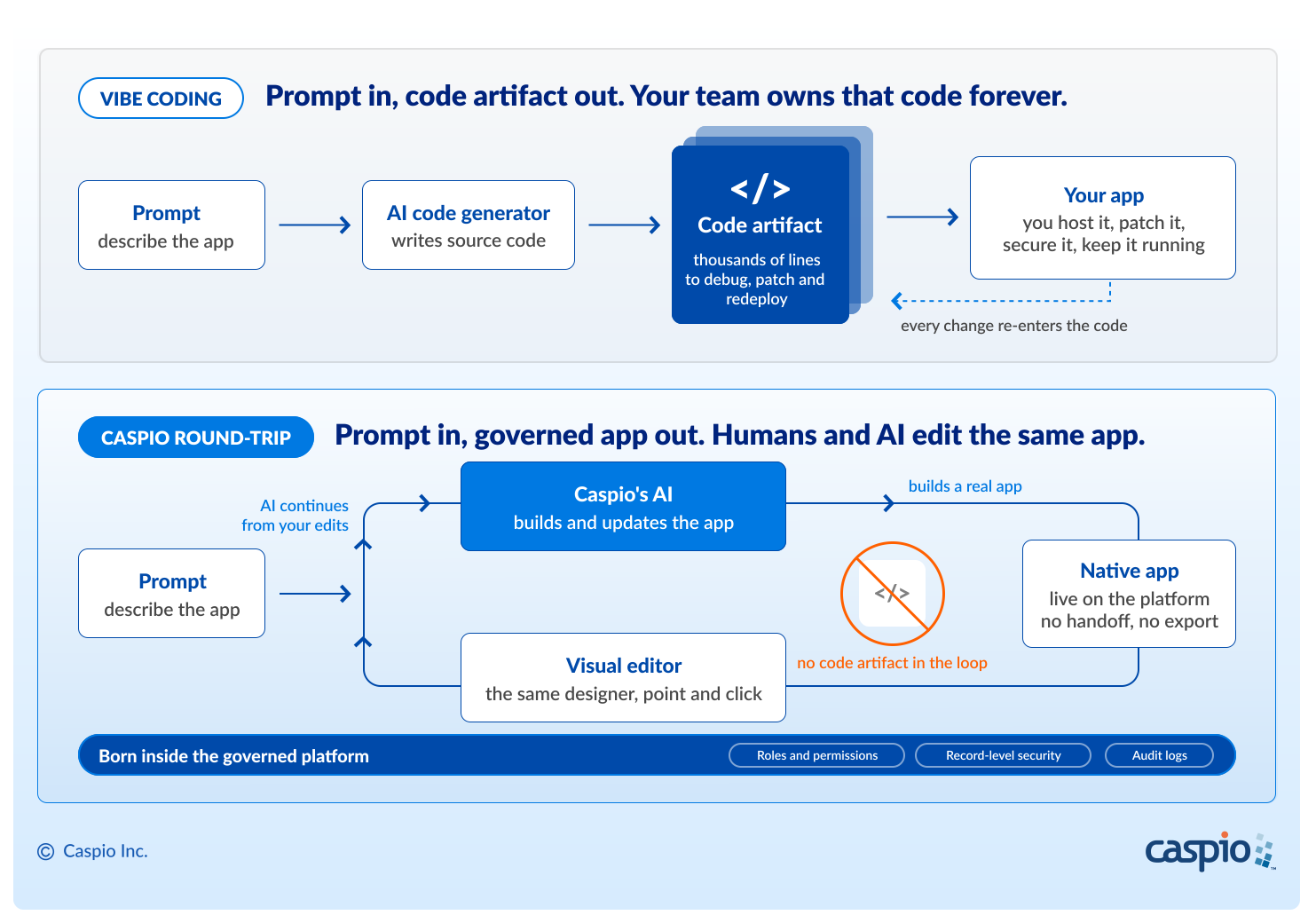
This is why “scan the output harder” is not an answer. Scanning finds flaws in an artifact; it cannot retrofit a governance layer around one. The five approaches below all work by changing where the AI’s output lives, not by inspecting it more aggressively.
5 Secure Alternatives to Vibe Coding for Business Apps
An honest list. Different teams will choose differently, and more than one of these approaches can run side by side. For a full evaluation framework, see our guide to AI app builders for regulated industries.
1. Build on a governed application platform where AI works inside certified controls
Instead of an AI that emits code, use a platform where the AI builds a native application inside the platform’s existing security model. Caspio takes this approach with a governed round-trip: you prompt Caspi (formerly branded AI Assistant), it builds a real app on the platform, your team refines it in the same visual designer, and the AI continues from those edits. There is no code artifact in the loop, so there is nothing to export, patch, or lose track of. Every app is born with roles and permissions, record-level security, and audit logs, and deploys as a complete Caspio-hosted application, or as embeddable components on your own site.
The compliance posture is the differentiator: AI builds it; the platform it lives on carries annually certified HIPAA and SOC 2 Type II. That is annual independent certification, not self-attestation. Pricing is flat, starting from $300/month with unlimited users, so a successful app does not become a budget problem (there is no free plan; a 14-day trial is available, with 24/7 human support). Teams handling PHI add Caspio’s HIPAA add-on, which carries the signed BAA. That add-on is published at $500/month on top of the plan rate with a one-year minimum term.
Best for: Business teams and IT departments building data-driven apps on regulated or sensitive data, and anyone who wants AI speed without owning generated source code.
2. Keep AI codegen, but run it inside a professional secure SDLC
If your organization has engineers and an application security function, AI-assisted coding can be governed the way all code is governed: mandatory human review, SAST/DAST scanning, secrets detection, dependency controls, and a deployment pipeline that generated code cannot bypass. It works precisely because the humans in the loop already know what good looks like.
The honest costs: it requires the engineering organization vibe tools promise to make unnecessary, and the Veracode data means review capacity must scale with generation volume, which is exactly what most companies are not doing today.
Best for: Software organizations with dedicated engineering and AppSec capacity building products, not internal business apps.
3. Use enterprise internal-tool platforms with centralized IT governance
Platforms such as Retool and Superblocks pair AI generation with centrally managed permissions, SSO, and self-hosting options. Their genuine strength is developer-grade control for internal tooling. The trade-offs are documented and structural: they are developer-centric platforms, so business teams still queue behind engineering, and per-seat pricing means cost scales with every user you add, with compliance features typically gated to top tiers. For that use case in depth, see our roundup of the best AI tools for building internal business apps.
Best for: Engineering-led teams building internal tools for a bounded number of internal users, without regulated-data requirements.
4. Restrict vibe tools to prototyping, with synthetic data only
A prototype-only policy keeps the genuinely useful part of vibe coding: a product manager can make an idea tangible in an afternoon. The policy line is simple: vibe-built apps never touch production data, never collect real user data, and never go live outside a sandbox. When a prototype earns promotion, it gets rebuilt on a governed path (approach 1, 2, or 3). Write the policy down; our vibe coding governance checklist is a starting template.
Best for: Product and innovation teams validating concepts before committing build resources.
5. Already shipped? Audit, contain, then re-platform
If your team already has a vibe-built app live, treat it as an exposure until proven otherwise. Inventory what exists (the Red Access findings came from apps IT did not know about), take public defaults private, rotate every credential the generator ever touched, and review what data the app collected.
Then face the retrofit-versus-rebuild decision honestly, because the retrofit math is brutal for regulated use cases. There is no published market rate for taking a vibe-built health app to HIPAA compliance, and the documented downside is severe: Ponemon Institute’s benchmark research found that failing at compliance costs organizations 2.65 times what compliance itself costs, healthcare breaches averaged $6.64 million per incident in IBM’s 2026 Cost of a Data Breach study, and OCR penalties reach $2,190,294 per violation category per year, with the process work (training, penetration testing, risk analysis) repeating annually. The compliance wall behind those numbers is contractual, not just technical: Lovable’s own Data Processing Agreement (Section 3, updated November 2025) has customers agree not to upload, input, or otherwise provide any protected health information under HIPAA, and Replit staff wrote on their own forum in May 2025, “we haven’t prioritized it and probably won’t for this year” (the question was re-asked in March 2026 with no staff answer). Rebuilding on a platform that already carries the certifications is usually faster and cheaper than retrofitting certification onto an artifact. See the dated, sourced verdicts for Lovable, Replit, and Bolt.
Best for: Teams with a vibe-built app already in use, especially anywhere near customer, financial, or health data.
Comparison: Governance Model and Compliance Posture
| Approach | Governance model | Compliance posture | Best for |
|---|---|---|---|
| Governed platform, AI round-trip (e.g., Caspio) | Governance by architecture: roles, record-level security, and audit logs are platform properties every app inherits; no code artifact to secure | Platform carries annually certified HIPAA and SOC 2 Type II (annual independent certification); BAA available with the HIPAA add-on ($500/month on top of the plan rate, one-year minimum) | Business apps on regulated or sensitive data; teams without dedicated engineering |
| AI codegen inside a secure SDLC | Governance by process: human review, SAST/DAST, secrets scanning, controlled pipelines | As strong as your own program; you certify what you build and carry the audit burden yourself | Software organizations with AppSec capacity |
| Enterprise internal-tool platforms (Retool, Superblocks) | Governance by administration: centrally managed permissions, SSO, self-hosting; developer-operated | Varies by vendor and tier; compliance features typically gated to top plans; per-seat cost scales with users | Engineering-led internal tools, non-regulated data |
| Vibe tools, prototype-only policy | Governance by boundary: synthetic data only, sandboxed, never production | None needed if the boundary holds; the policy is the control | Concept validation before a governed build |
| Audit, contain, re-platform (already shipped) | Governance by remediation: inventory, contain exposure, rotate secrets, then move to a governed path | Retrofitting compliance onto an artifact carries no published market rate and a documented downside of $6.64M per average healthcare breach (IBM, 2026) plus OCR penalties up to $2,190,294 per violation category per year (HHS); rebuilding on a certified platform is usually the shorter path | Teams with live vibe-built apps |
For the broader field, the best HIPAA-compliant app builders.
Frequently Asked Questions
Is vibe coding secure?
Not by default. Escape.tech found 2,000+ high-impact vulnerabilities and 400+ exposed secrets across 5,600+ publicly available vibe-built apps; Red Access found 2,000+ of 380,000 scanned assets exposing sensitive data at public URLs with no exploitation required; and Veracode’s longitudinal benchmark shows AI secure-generation rates flat at roughly 55% for two years. Vibe coding can be used safely for prototypes with synthetic data, but a vibe-built app holding real business data needs a governance layer the tools do not provide.
Can vibe-coded apps be HIPAA-compliant?
On standard terms, no. Lovable’s Data Processing Agreement has customers agree not to provide PHI to the platform, and Replit staff have said a BAA is not being prioritized. Retrofitting a vibe-built health app to HIPAA has no published market rate, and the documented cost of getting it wrong is steep: healthcare breaches averaged $6.64 million per incident in IBM’s 2026 study, and OCR penalties reach $2,190,294 per violation category per year. The workable pattern is to build on a governed platform instead: AI builds it; the platform it lives on carries annually certified HIPAA and SOC 2 Type II, with a BAA available as a published add-on on top of any plan’s rate.
What is governed AI app development?
Governed AI app development means the AI builds inside a platform whose security controls (roles and permissions, record-level security, and audit logging) apply to everything it produces, rather than emitting a standalone code artifact your team must secure after the fact. Governance is a property of where the app lives, not a review step bolted on afterward.
My team already built an app with a vibe coding tool. How do I make it secure?
Contain first: take public defaults private, rotate every credential and API key the tool touched, and review what data the app collected. Then inventory any other AI-built apps in the organization, since shadow apps are where the documented exposures came from. Finally, decide between hardening the code artifact (realistic only with engineering and AppSec capacity) and rebuilding on a governed platform, which is usually the shorter path for anything touching sensitive data.
Won't vibe coding tools just become secure over time?
The model data says not soon: Veracode’s benchmark shows secure-generation rates virtually unchanged in two years despite large capability gains. Vendors will add certifications, and verdicts should be re-checked quarterly. But certification of the vendor does not govern your app; Base44 advertises SOC 2 Type II and ISO 27001 today, and Wiz still documented a critical auth bypass on customers’ private apps. As long as the deliverable is an ungoverned code artifact, the structural problem remains.


Recommended Articles

Online Database With a SQL Backend: 7 Questions to Ask
READ STORY 9 Vibe Coding Security Risks in AI-Generated Apps
READ STORY Build Custom Business Apps Easily: 3 Patterns
READ STORY Caspio AI Connector Extensions: 5 Jobs for Your Tables
READ STORY PHI and Caspio AI: Which Features Your BAA Covers
READ STORY How AI Agents Buy Software, and Why Legibility Wins
READ STORY Build Internal Tools With AI: Best Tools for Business (2026)
READ STORY 10 Questions to Ask Before Connecting AI to Business Data
READ STORY Add a Role-Aware AI Chat Agent to Your Caspio App
READ STORY Lovable Alternatives for Business and Regulated Apps (2026)
READ STORY Vibe Coding vs. Low-Code: Key Differences and Where Caspio Fits in 2026
READ STORY Vibe Coding Governance: The IT Leader’s 2026 Checklist
READ STORYSubscribe for More Updates

