The 80/20 Modernization Strategy: How to Build Around Legacy Systems With Low Code
March 25, 2026

It usually starts with a reasonable request.
A department head flags an operational issue that keeps slowing the team down.
“We need a way to track vendor certifications, so we don’t lose our compliance rating.”
“We need a dashboard that pulls data from three regions so we can see inventory in one place.”
These are not radical transformations. They are specific, contained improvements tied directly to how work gets done.
The response from IT, however, is often predictable.
“We don’t have the bandwidth.”
“The platform wasn’t built for that.”
“That would require custom development.”
The issue is rarely that the core system is broken. It’s that the system is rigid. It functions as a fixed object inside a business environment that changes constantly.
As a result, organizations tend to feel boxed into two options. They either accept the limitations of their existing systems, or consider replacing them entirely, even when those systems still handle most of what they were designed to do.
There is a third path that gets far less attention. Modernize by building what’s missing around your legacy systems instead of replacing them.
The 80/20 Gap Most Teams Don’t Plan For
Enterprise systems are designed to handle core functions at scale. ERPs manage financial transactions, CRMs structure customer data, and HR systems support payroll and benefits administration. For most organizations, these platforms cover the majority of operational needs.
However, they rarely cover everything. In practice, they typically solve about 80% of the workflow. The remaining 20%, the part that reflects how teams actually operate day to day, often doesn’t fit cleanly into predefined modules, rigid schemas, or standard system logic.
That missing 20% doesn’t disappear. It spills into other places.
Spreadsheets become tracking systems.
Email threads replace structured workflows.
Manual processes fill in for missing automation.
Critical knowledge lives in people’s heads instead of in systems.
The cost isn’t just inefficient. It’s fragmentation. Important operational data ends up scattered across tools that were never designed to work together or to function as systems of record.
When Temporary Fixes Become Permanent Infrastructure
Most shadow systems start as stopgaps.
A team asks for automation to prevent missed certification renewals. The answer is that it would take custom development or platform changes that aren’t currently planned.
Someone builds a spreadsheet to bridge the gap. It works well enough to keep things moving.
Over time, the spreadsheet becomes the source of truth. People stop updating the core system because the spreadsheet reflects reality more accurately.
Eventually, the workaround becomes embedded in daily operations. It’s relied on, shared widely, and critical to outcomes, even though it lacks governance, access control, integration, or durability.
At that stage, teams trust neither the official system nor the workaround completely. Data consistency suffers, and fixing the problem feels harder than it did at the beginning.
Modernization Without Replacement
Modernization does not have to mean replacing systems that are already stable and widely adopted.
A practical alternative is to build a lightweight application layer around existing platforms. This layer focuses on the specific workflows, data capture, and operational logic that core systems don’t handle well.
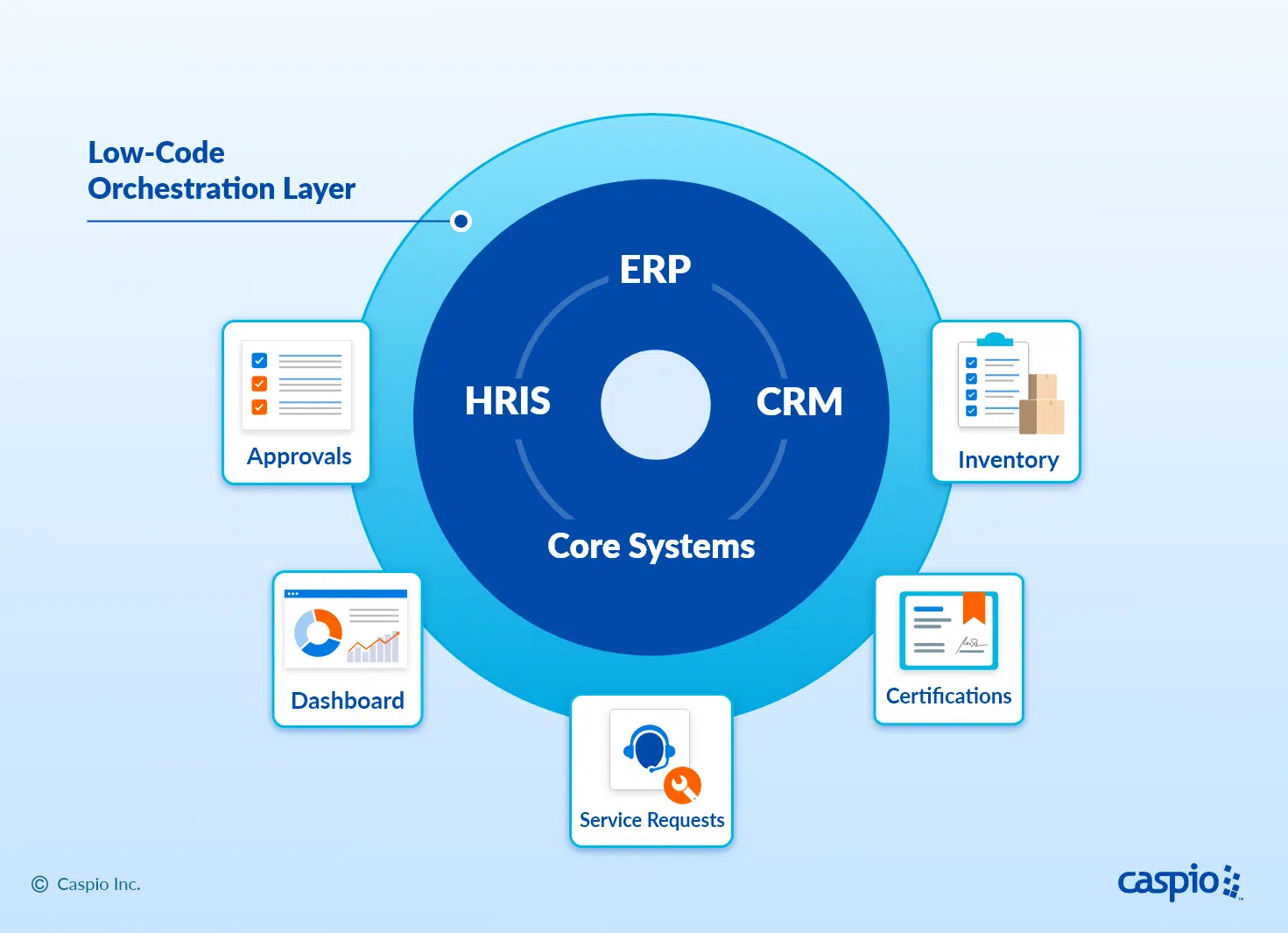
The 80/20 Modernization Model: A low-code orchestration layer extends core systems like ERP, CRM, and HRIS to close workflow gaps without replacing existing infrastructure.
With Caspio, tools can be built without writing custom code. Web interfaces, forms, dashboards, data models, workflow rules, and integrations can be configured within the platform rather than developed from scratch. This significantly reduces the time and technical overhead compared to traditional custom development.
This approach does not mean sacrificing governance. Applications built in Caspio operate within a structured environment that supports role-based permissions, controlled data access, and centralized management. Instead of relying on spreadsheets or disconnected tools, teams can move operational processes into applications that are governed and auditable.
Caspio supports integration with existing systems through APIs and data connections, allowing organizations to extend ERP, CRM, HRIS, or other core platforms rather than replace them. For user management, Caspio can integrate with an organization’s existing identity provider, enabling single sign-on and consistent authentication across internal tools.
Teams do not have to begin from a blank slate. Caspio provides a library of prebuilt application templates covering common operational use cases. These templates serve as structured starting points that can be customized to fit specific workflows, accelerating deployment while maintaining consistency and control.
Core systems remain in place and continue doing what they do well. The missing workflows are addressed in a secure, structured application layer built specifically to close the 20% gap.
What the “Orchestration Layer” Looks Like in Practice
This orchestration-layer strategy isn’t theoretical. Organizations across industries are already using low-code platforms like Caspio to extend their existing systems rather than replace them.
Example #1: Internal Workflow Portals Replacing Spreadsheet Processes (Marriott International)

The Problem: At Marriott, teams needed to manage internal workflows such as goal tracking, approvals, and performance processes, but many of these were still handled in spreadsheets despite having enterprise systems in place.
The Gap: Those systems didn’t support the specific workflows teams relied on day to day, forcing continued use of manual, spreadsheet-based processes.
The Caspio Solution: Marriott used Caspio to build internal portals and workflow tools that replaced spreadsheets and supported operational processes without replacing existing platforms.
Why it matters: Marriott addressed real operational gaps by building targeted applications around their core platforms instead of forcing teams to adapt to tools that didn’t fit.
Example #2: Custom Operational Tools for Service and Delivery Teams (Hitachi Vantara)

The Problem: Hitachi Vantara’s service and delivery teams needed operational management tools that reflected their internal workflows, approvals, and service processes. Standard systems didn’t always align with how these teams managed their work.
The Gap: Without tools designed for their specific operational needs, teams relied on spreadsheets and disconnected internal processes to track service activities and manage workflows.
The Caspio Solution: Hitachi Vantara used Caspio to build customized service and operational management tools tailored to their internal workflows.
Why it matters: This allowed service teams to work within systems designed around their actual processes rather than adapting their work to rigid platforms.
Example #3: Regional Service Center Applications for Core Operations (Lenovo)

The Problem: Lenovo’s regional service centers needed systems to manage invoicing, inventory, and helpdesk operations. However, these operational needs weren’t fully addressed by centralized enterprise platforms.
The Gap: Without purpose-built applications, service centers relied on manual processes and fragmented tools that made operations harder to manage consistently across regions.
The Caspio Solution: Lenovo used Caspio to build applications that supported regional service center workflows, including invoicing, inventory management, and helpdesk support.
Why it matters: Lenovo filled critical operational gaps by building department-level applications that complemented existing systems.
In each case, the goal was not to overhaul existing enterprise platforms, but to extend them. By building targeted applications around stable systems of record, these organizations were able to close operational gaps, improve visibility, and introduce governance without triggering the cost and risk of large-scale replacement projects.
Why This Strategy Isn’t More Common
Even when the need is clear, many organizations hesitate to build around their core systems.
Platforms Are Treated Like Boundaries
Enterprise platforms are often treated as boundaries rather than foundations. If a feature isn’t native to the system, it’s assumed out of scope, even when the workflow is mission critical.
The People Closest to the Problem Don’t Control the Solution
Departments experience operational gaps firsthand, but IT teams must prioritize across the entire organization. Those priorities are often shaped by backlogs, security requirements, and vendor constraints.
The Old Assumption Still Exists
There’s still a belief that building custom tools requires a large development team and long timelines. That assumption made sense when every workflow improvement required traditional coding.
Low-code platforms change this dynamic by reducing the effort required to build internal applications. While IT oversight may still be needed for governance, security, and integrations, departments no longer have to wait for full development cycles to solve operational problems that fall outside standard enterprise workflows.
What It Actually Takes (And What It Doesn’t)
Closing the 80/20 gap doesn’t require an enterprise-wide reset. In most cases, it requires a more focused approach, one that targets workflow breakdowns without disturbing systems that are already stable.
What it takes:
- A clearly defined workflow that isn’t working today
- A mapped understanding of where data currently lives (ERP, CRM, HRIS, spreadsheets, etc.)
- Access to the relevant system data (via API, exports, or database connections)
- A business owner accountable for the process and outcomes
- A low-code platform that can support secure workflows, role-based access, and integrations
What it doesn’t take:
- Replacing your ERP, CRM, HRIS, or EHR
- Launching a multi-year transformation project
- Waiting for vendor roadmaps or internal backlogs to clear
- Rebuilding systems that already handle core transactions well
Modernization becomes far more manageable when it’s modular: solving the missing 20% without disrupting the 80% that already works.
The Question That Unlocks Real Progress
Many organizations ask, “How do we get IT to prioritize this?”
More strategic organizations ask, “What would it take to build the missing layer ourselves?”
Legacy systems are not obstacles. They provide stability and structure, but they don’t have to dictate how every workflow operates. Modernization does not always demand replacement. In many cases, it simply requires extending what already works and addressing the missing 20% with intention.
That shift in mindset, from replacement to orchestration, is where real progress begins.
Ready to close the workflow gaps your enterprise systems weren’t built for? Schedule a free consultation today and discover a smarter way to modernize.
Recommended Articles

Introducing the Caspio MCP Server
READ STORY
Why Citizen Developers Need Governance in Low-Code Platforms
READ STORY
How to Extend Your Student Information System | Secure Low-Code for Higher Ed
READ STORY
Citizen Developers: The Future of Enterprise Low-Code Development
READ STORY
How a Two-Person Team Digitized Tribal Health Across the Southwest Using Caspio
READ STORY
12 Caspio Features You Might Be Overlooking
READ STORY
When Off-the-Shelf Isn’t Enough: Build an Inventory System That Fits
READ STORY
Why Arizona Autism Replaced Quickbase With Caspio to Scale Securely and Cut Costs
READ STORY
Vibe Coding vs. Low-Code: Where Caspio Fits in the Future of Application Development
READ STORY
Build a SaaS Startup Without a CTO: How Low Code Empowers Solo Founders
READ STORY
Can Low-Code Platforms Support Enterprise Apps
READ STORY
Build an AI-Enhanced Applicant Tracking System With No-Code
READ STORY
