Code Artifact vs. Governed Platform: The Two Architectures of AI-Built Software
September 10, 2026

Every AI app-building tool, whatever its marketing says, emits one of two things: a code artifact, meaning source code your team owns, hosts, patches, and secures from that day forward, or a governed platform app, an application born inside a platform’s access model, where security is inherited rather than assembled. This fork, not model quality, is the best predictor of total cost of ownership, security posture, and who can maintain the result.
The AI app-builder market does not organize itself this way. Vendors sort themselves by audience (developers, business users), by interface (chat, canvas), or by hype register (“vibe coding” is the loudest of these). None of those labels tells you what you will be operating a year after the build. The output architecture does. And the volume argument for getting this right is not speculative: Gartner predicts that by 2028, 40% of new enterprise production software will be created with vibe coding techniques and tools (Gartner, May 2025, as reported by CIO Dive). Note Gartner’s scope: that figure covers AI-assisted development broadly, including professional developers, not only citizen builders. Either way, a large share of new software will soon arrive through one of these two doors.
Neither architecture is wrong. Each fits a different kind of team, and the tradeoffs run both ways. What follows is the taxonomy, the honest case for each side, and the three questions that reveal which one a given tool actually sells.
Architecture 1: The Code Artifact
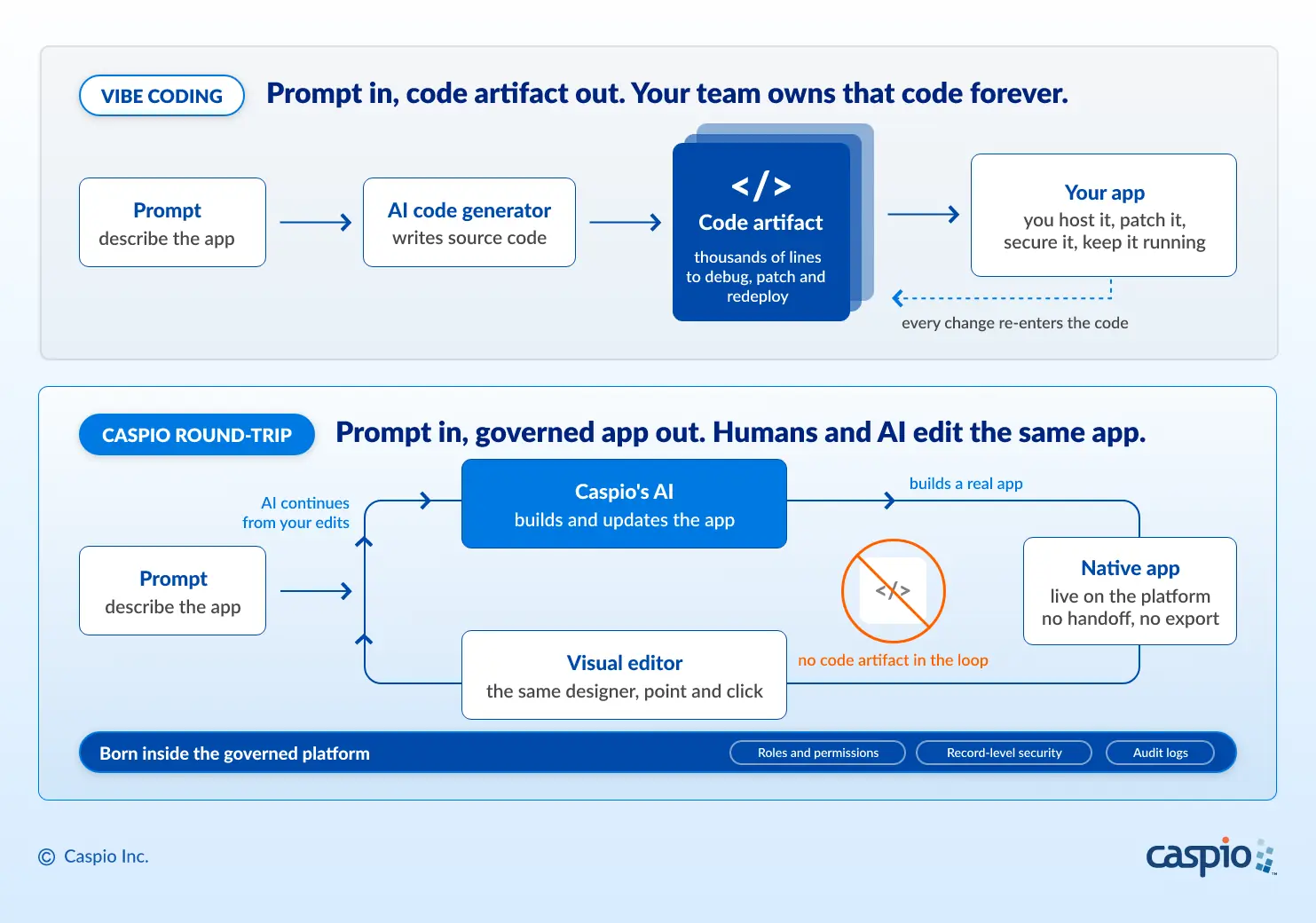
The first architecture is a generation pipeline. You describe the application in a prompt. An AI code generator writes source code: application logic, database schema, authentication, deployment configuration. The output is a repository, and from the moment it exists, it belongs to your team. The loop looks like this:
Prompt → AI code generator → code artifact → your team, forever.
Every future change re-enters the code. A new field, a permissions fix, a dependency patch, a security finding: each one is a change to source files that someone in your organization must make, review, test, and redeploy. The AI can help with those changes too, but only at the code level, because code is the only surface this architecture has.
The Honest Case For the Code Artifact
The strengths are real and, for the right team, decisive.
- Unlimited flexibility. It is code. Any behavior, any integration, any UI, any algorithm a developer could write, the artifact can contain. There is no platform boundary to hit.
- Portability. You can host it on any cloud, move it between vendors, fork it, and extend it with any library in the ecosystem. No single vendor controls its runtime.
- Standard toolchains. Version control, code review, CI/CD, testing frameworks, and observability all apply. Any developer you can hire can, in principle, work on it.
- Fit for engineering organizations. Teams that already run a secure software development lifecycle can fold AI-generated code into the same review gates, scanners, and pipelines that govern human-written code.
That last point also defines the boundary of the honest case. Every strength above assumes an engineering organization is standing behind the artifact.
The Maintenance Economics
A code artifact converts a build-time convenience into an ownership liability. The generation step is fast and cheap; ownership is neither. Someone now owns thousands of generated lines, whether or not anyone on the team can read them, and owns them for the life of the application. Governance is not included: roles, record-level permissions, audit logging, and backup policy are features someone must know to request, then verify line by line, then maintain through every regeneration. The cost curve reflects this. Costs concentrate not in the build but in the years after it, and pricing models amplify the effect: Gartner predicts that 40% of enterprises using consumption-priced AI coding tools will face unplanned costs exceeding twice their expected budgets by 2027 (Gartner Predicts 2026, December 2025, as reported by ArmorCode).
What the Security Data Shows
If generation quality were improving fast enough, the ownership burden would be temporary. The longitudinal data says it is not. Veracode’s Spring 2026 GenAI Code Security update, a published benchmark run across 150+ LLMs on the same tasks over two years, found AI secure-generation rates flat at roughly 55% despite capability gains (Veracode, March 2026). Reasoning-focused models did better, reaching 70 to 72%. That bright spot deserves stating, and so does its ceiling: a 70 to 72% secure-generation rate still means roughly 3 in 10 generation tasks introduce a known flaw, which is not shippable in a regulated app and a poor baseline for any app holding real business data. Field results match the benchmark: when Escape.tech scanned more than 5,600 publicly available vibe-built apps in late 2025, it found 2,000+ high-impact vulnerabilities, 400+ exposed secrets, and 175 instances of PII including medical records (published methodology). The full failure record, and what to do about it, is covered in our guide to secure alternatives to vibe coding.
None of this indicts the architecture for teams equipped to own it. It quantifies what “owning it” means.
Architecture 2: The Governed Platform
The second architecture has no artifact. You describe the application in a prompt, and the AI builds a native object inside an application platform: tables, forms, reports, workflows, and permissions that exist as configuration of the platform, not as exported source code. The loop is closed:
Prompt → AI builds a native app → the app lives on the platform → humans and AI keep editing the same app.
Two properties follow from the architecture, and both are structural rather than promised.
Governance is inherited at birth. The platform’s access model applies to the app the moment it exists. Roles and permissions, record-level security, and audit logging are properties of where the app lives, not features someone remembered to prompt for. There is no window between “generated” and “secured,” because the two are the same event.
Editing is round-trip. Because the app is a native platform object, a human can open it in the platform’s visual editor and change it directly, and the AI continues from those edits. There is no divergence between “what the AI generated” and “what the humans changed,” because there is only one object. In the code-artifact world, the edit surface is always source code; in the governed-platform world, the edit surface is the application itself.
Caspio’s implementation is a concrete example of the pattern, drawn below: a prompt goes to Caspi, Caspio’s AI builder, which builds and updates the app as a native platform object. The two panels of the diagram state the fork in one glance. The code-artifact lane: “Prompt in, code artifact out. Your team owns that code forever.” The governed-platform lane: “Prompt in, governed app out. Humans and AI edit the same app.”
The Honest Case Against the Governed Platform
The tradeoffs here are real, and a taxonomy that hides them is not worth citing.
- The platform boundary is a boundary. A governed platform expresses applications in its own building blocks. Data-driven business applications, forms, dashboards, portals, and workflow fit naturally. Arbitrary customization does not: a novel algorithm, an exotic interface, or a capability the platform has not built is either impossible or requires working through the platform’s extension points rather than writing free-form code.
- You operate within the platform’s capabilities. Feature depth, integration coverage, and performance characteristics are the vendor’s roadmap, not yours. Evaluation diligence shifts from “can we build it” to “can this platform do it,” and that question must be answered before commitment, not after.
- Vendor dependence is real. The platform’s uptime, security program, pricing, and terms become load-bearing for every app on it. This is why the evidence class matters (covered in the table below): a platform asking to carry your governance should prove its own with independent certification, not self-attestation.
The clean way to summarize the fork: the code artifact gives you unlimited scope and makes you responsible for everything; the governed platform takes responsibility for the operating environment and gives you its scope.
The Comparison
The two architectures, side by side, on the criteria that determine what you operate after the build. These rows describe the architectures generically, not any single vendor.
| Criterion | Code artifact | Governed platform |
|---|---|---|
| Output type | Source code: a repository of generated files you deploy and run | A native platform object: configuration living inside the platform’s runtime |
| Who maintains it | Your team, for the life of the app: patches, dependencies, redeploys, security fixes | The platform maintains the runtime and controls; your team maintains the app’s design and data rules |
| Governance model | Assembled by hand: roles, record-level permissions, and audit logging must be generated correctly, verified, and re-verified after every change | Inherited at birth: the platform’s access model, record-level security, and audit logging apply to every app automatically |
| Edit model | Regenerate or hand-edit the code; every change re-enters the artifact, and human edits and AI output must be reconciled at the source level | Round-trip: humans edit the live app in a visual editor and the AI continues from those edits; one object, no divergence |
| Compliance evidence class | Evidence you assemble: your own pen tests, audits, and certifications, per application, repeated on your calendar | Evidence you inherit: the platform’s independent certifications cover the environment every app lives in; you remain responsible for how you configure apps and handle data |
| Cost shape | Low entry cost; spend concentrates in ownership: maintenance, security, and audit, with consumption pricing adding variance | Subscription entry cost; ownership spend stays inside the subscription; variance comes from plan tier and user model, which differ by vendor |
Read the table as a matching exercise, not a scorecard. An engineering-led product team maps naturally to the left column. A business or IT team building data-driven apps on sensitive data maps naturally to the right. For a full evaluation framework applied to specific vendors, see our guide to AI app builders for regulated industries.
How to Tell Which One You Are Buying
Marketing language will not tell you which architecture a tool sells. Demo videos look identical: prompt in, working app out. Three questions cut through in an evaluation call, and every vendor can answer them in one sentence if they want to.
1. What exactly do I possess after the build?
This is the fork question. If the answer is a repository, a codebase, an export, or “your code,” you are buying a code artifact, along with everything ownership implies: hosting, patching, dependency management, and security review, forever. If the answer is an application running inside the vendor’s platform, you are buying a governed platform object, and your diligence should shift to the platform’s capabilities, certifications, and terms. Neither answer is disqualifying. Not knowing the answer is.
2. Who applies the security model?
For a code artifact, the security model is whatever the generator produced plus whatever your team adds, and the published benchmark data above says the generated part cannot be assumed correct. Ask what roles, record-level permissions, and audit logging exist by default, and who verifies them after each regeneration. For a governed platform, ask the mirrored question: which controls does every app inherit automatically, and which independent certifications back the platform’s own claims. “Ready” and “aligned” are postures; a certification with an annual independent audit is evidence.
3. Can a human and the AI edit the same object?
This question exposes the edit model. In artifact architectures, human edits and AI regeneration meet in source code, and reconciling them is engineering work. In round-trip architectures, a human changes the live app in a visual editor and the AI continues from the changed state. If a vendor’s answer involves branches, merges, or “regenerate and re-apply your changes,” it is an artifact architecture regardless of how the product is positioned.
If you are asking these questions after the fact, because your organization already owns an AI-generated artifact, the decision framework changes: see our analysis of whether to rebuild or retrofit an AI-built app.
A Worked Example: The Round-Trip on a Governed Platform
Caspio is a concrete implementation of the second architecture, and it illustrates how the structural properties above show up in practice. A builder describes the application, and Caspi builds it as a native app on the platform: no export step, no repository handoff. The app is live inside Caspio’s access model from the first moment, with roles and permissions, record-level security, and audit logs as platform properties rather than prompt outcomes. From there, the loop stays closed. A team member opens the same app in the visual editor, adjusts a report or a permission rule by pointing and clicking, and Caspi continues building from that edited state. Finished apps deploy as fully hosted standalone apps or as embeddable components on the organization’s own site, and the platform’s pricing model does not meter deployment by headcount: plans include unlimited users.
For regulated teams, the architecture carries the compliance posture with it. AI builds it; the platform it lives on carries annually certified HIPAA and SOC 2 Type II. That is annual independent certification of the environment every app inherits, which is precisely the evidence class the comparison table assigns to this architecture. The generic tradeoffs apply here as they do to any governed platform: the application vocabulary is the platform’s, and the right evaluation is whether your use cases, typically data-driven business applications, portals, and workflow, fit that vocabulary. That is the matching exercise the taxonomy exists to frame.
The inheritance now extends past build time. An AI Agent can be added to any Caspio app like any other component, giving app users a chat interface over the app and its data. The agent operates under the signed-in user’s role, so record-level security holds for AI access exactly as it does for human access, and field-level security set at design time constrains the agent further, on top of whatever the user can see. It can also carry its own knowledge base. In taxonomy terms, the governed platform’s defining property, controls inherited from where the software lives, applies whether the AI is building the app or answering questions inside it.
Frequently Asked Questions
Who owns AI-generated code?
Under most AI coding tools’ terms, the customer owns the generated code, and ownership is the point: it includes the obligations. Your organization hosts, patches, secures, and audits that code for the life of the application, whether or not anyone on staff can read it. On a governed platform, there is no code artifact to own; the vendor operates the runtime and controls, and you own your app design and data.
What is a code artifact?
A code artifact is the output of an AI code generator: source code files, typically thousands of lines covering application logic, data schema, and authentication, delivered as a repository your team must deploy and maintain. It is one of the two possible outputs of an AI app builder; the other is a native app on a governed platform, which exists as platform configuration rather than exported code.
Can AI-built apps be governed?
Yes, by architecture or by process. On a governed platform, every AI-built app inherits the platform’s roles, record-level security, and audit logging at creation, so governance is structural. With code artifacts, governance is achievable through a mature secure development lifecycle: mandatory review, scanning, and controlled pipelines, which requires an engineering organization. What does not work is generating artifacts with neither.
Are "no-code" and "governed platform" the same thing?
No. The taxonomy cuts across marketing categories. Some tools marketed to non-developers still emit code artifacts the customer must host and maintain, and some developer-oriented platforms keep apps as governed native objects. Ignore the audience label and ask the output question: what exactly do you possess after the build?
Which architecture is right for my team?
Match the architecture to the team standing behind the app. Choose the code artifact if you have engineering and application security capacity, need unrestricted customization, and want portability across hosts. Choose the governed platform if the app is a data-driven business application, the builders are business or IT teams rather than a dev organization, or the data is regulated and you need the environment’s compliance evidence to be inherited rather than assembled.
Recommended Articles

Build Internal Tools With AI: Best Tools for Business (2026)
READ STORY
10 Questions to Ask Before Connecting AI to Business Data
READ STORY
Add a Role-Aware AI Chat Agent to Your Caspio App
READ STORY
Lovable Alternatives for Business and Regulated Apps (2026)
READ STORY
Vibe Coding vs. Low-Code: Key Differences and Where Caspio Fits in 2026
READ STORY
Vibe Coding Governance: The IT Leader’s 2026 Checklist
READ STORY
Shadow AI Apps Are the New Shadow IT: A 2026 Guide
READ STORY
Secure Alternatives to Vibe Coding for Business Apps (2026)
READ STORY
AI App Builders for Regulated Industries: 2026 Buyer's Guide
READ STORY
AI and No-Code: Generative AI in App Development
READ STORY
Per-User Pricing vs Flat Rate: The Unlimited Users Math
READ STORY
Rebuild or Retrofit After a Failed Security Review (2026)
READ STORY
