What Is Low Code?
Low code is a software development method that replaces most hand-written code with visual tools: drag-and-drop interfaces, prebuilt components, and configurable logic running on managed infrastructure.
It changed how business applications get built. AI is changing it again, and the platform underneath matters more than ever.
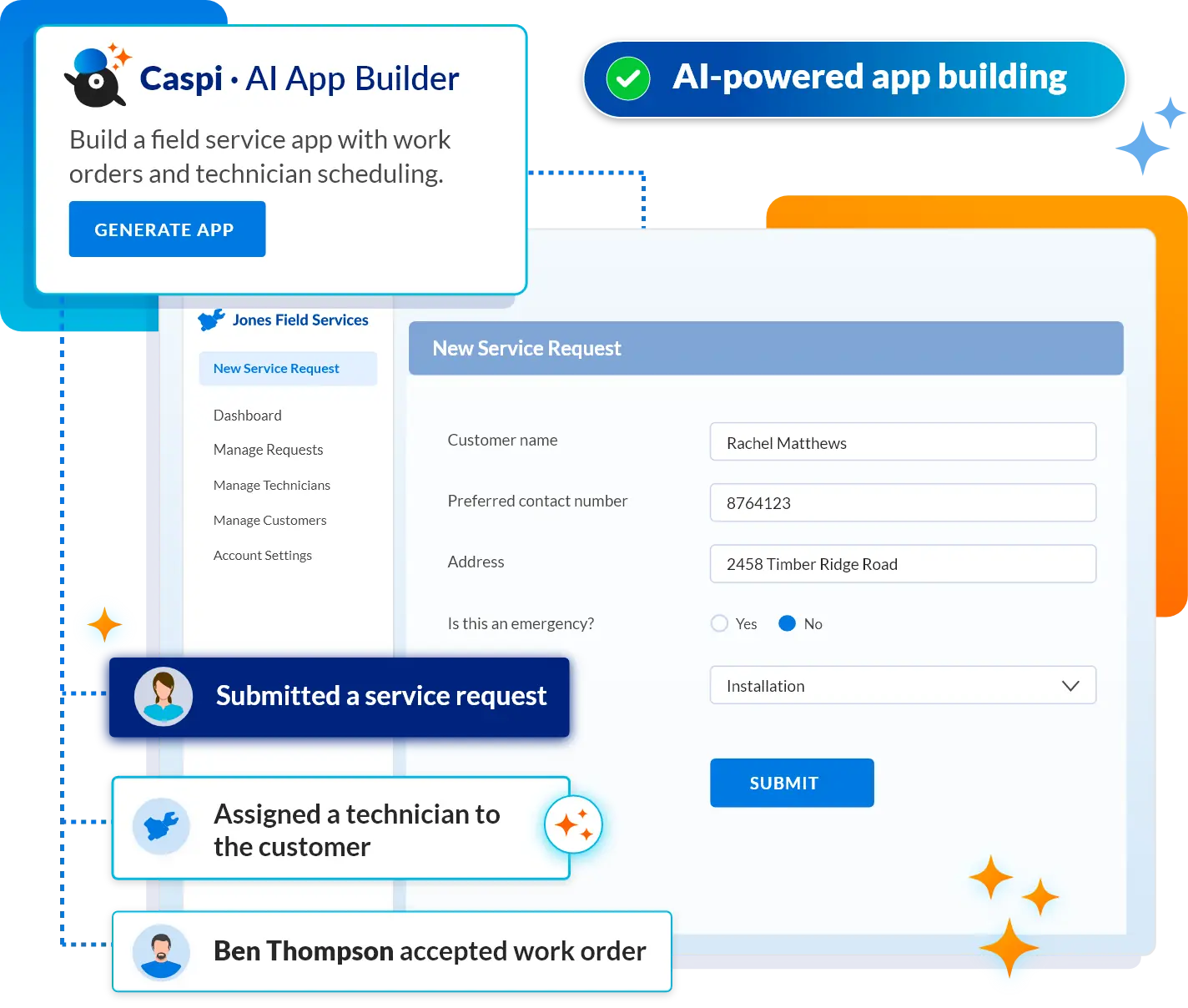
What Is Low-Code Development?
Low-code development is the practice of building software through visual configuration instead of writing and maintaining a codebase. Developers and technical business users assemble applications from prebuilt, pretested components, define data structures and logic through point-and-click tools, and deploy on infrastructure the platform manages. Compare that with traditional development. To build a business application by hand, a team writes code, provisions servers, builds authentication and access control, tests, patches, and maintains all of it for the life of the application. Low code collapsed that work into the platform itself. The platform supplies:

Visual development
Interfaces, forms, reports, and workflows built through configuration, not syntax.

Pre-built components
Authentication, search, notifications, and integrations that are already engineered and tested.

Governed infrastructure
Hosting, security, backups, and scaling handled by the platform, not your team.
The result is the method's core promise: production-grade applications in a fraction of the time, with no code artifact for your team to maintain. For a component-by-component look at what these platforms include, see our low-code platform guide. Caspio helped pioneer this category. Founded in 2000, Caspio has spent more than two decades building the governed platform engineering that low code depends on, which is exactly the foundation that matters most in what comes next.
Low Code vs. No-Code vs. AI App Building
Low code, no-code, and AI app building are three generations of the same promise: custom software without the cost and delay of traditional development. Here is how the industry uses each term.
| Comparison area | Low code | No-code | AI app building |
|---|---|---|---|
| What it means | Visual development on managed infrastructure, with the option to extend using code | An industry term for tools that promise app building with zero coding, usually through templates and preset configuration | You describe the application in plain language and AI generates it: data model, interface, and roles |
| Who builds | Developers and technical business users | Non-technical business users | Anyone who can describe what the business needs |
| How it is built | Point-and-click configuration of data, logic, and interfaces | Assembly within the boundaries the templates allow | Conversation first, then visual refinement of a real, editable application |
| The trade-off | Faster than coding, still built screen by screen | Simplest to start, most constrained at the edges | Fastest to a working application; quality depends on the platform underneath it |
AI app building is not a rejection of low code. It is the current evolution of it: the same governed components and infrastructure, now assembled by AI from a description instead of screen by screen by hand.
How Has AI Changed Low-Code Development?
AI replaced the slowest part of low-code development: assembling the application. Describe the app your business needs, and Caspio generates it, including the data model, interface, and roles, as a real, secure app your team fully owns and can edit, with no code to maintain.
That last part is the difference that matters. AI code generators hand you a codebase your team must now debug, host, and maintain, which recreates the exact burden low code was invented to remove.
On Caspio, humans and AI edit the same app through the same visual tools. There is no code artifact, no handoff, and no fork between what AI built and what your team maintains. Caspio's AI capabilities span the full life of an application:

Caspi
Builds and refines applications from a conversation: describe, generate, adjust, ship.
MEET CASPI
In-App AI Chat Agent
Answers your users' questions inside your finished applications, drawing on your app's data while respecting every role and permission you have set.
SEE HOW AI CHAT WORKS
AI Connector Extensions
Bring leading AI models directly into app workflows, from summarizing records to classifying incoming requests.
DISCOVER AI EXTENSIONS
Caspio MCP Server
Lets AI tools and agents work with your data under your permissions, alongside a documented REST API.
LEARN ABOUT MCP SERVERWhy the Platform Underneath Matters
An application is only as trustworthy as the platform it runs on, and AI has made that platform the deciding factor. When AI can generate an app in minutes, the question is no longer whether you can build it, but whether it can hold real business data, real users, and real regulatory obligations.
This is where more than two decades of governed platform engineering stops being history and becomes the proof. Every Caspio application, whether assembled visually or generated by AI, runs on the same certified platform: a SQL Server data core with role- and record-level security, deployed as a complete standalone app or as embeddable components, hosted on AWS with data residency in the United States, Canada, the European Union, the United Kingdom, Australia, and South America.
With Caspio, AI builds the application. The platform it lives on carries HIPAA, SOC 2 Type II, and GDPR compliance, independently certified annually. That is the difference between an impressive demo and a system a hospital, bank, or agency can actually run.

What Can You Build With Low Code and AI?
Anything built on structured data and defined roles: online databases, customer and partner portals, dashboards and reports, and workflow tools that route work between teams. These are the systems organizations actually run on, and the ones spreadsheets, email chains, and shared drives eventually struggle to support.
A few examples from regulated industries, where the certified ground matters most:
Patient intake and care coordination portals
that keep protected health information inside a HIPAA-compliant platform.
Permit, inspection, and case tracking systems
for government agencies that need auditability and controlled access.
Client onboarding and document workflows
for financial services firms managing sensitive records under strict retention rules.
Build them visually with the visual app builder, or describe them and let Caspi generate the first working version.
Built for the Industries With the Most at Stake


Why Teams Choose Caspio

AI on Every Tier
AI capabilities are included on every plan, giving every team access to AI-powered app building and productivity tools.
24/7 Human Support
Real people, around the clock, on every plan. Get help from Caspio’s in-house support team whenever you need it.
Unlimited App Users
Every plan includes unlimited users, with no per-seat fees as adoption grows. Add users across your organization without increasing your platform cost.
Certified Platform
AI builds the application. The platform carries annually certified HIPAA, SOC 2 Type II, and GDPR compliance.
25+ Years of Engineering
Founded in 2000, Caspio has spent more than two decades building governed infrastructure for business applications.
Deploy Where You Need It
Deploy applications as fully-hosted, standalone apps or embed them as components into websites, portals, and intranets.
Frequently Asked Questions
Low code is a software development method that replaces most hand-written code with visual tools: drag-and-drop interfaces, prebuilt components, and configurable logic on managed infrastructure. It lets developers and business teams build custom applications faster than traditional coding, while the platform handles security, hosting, and maintenance.
Low code combines visual development with the option to extend applications using code, and targets both developers and technical business users. No-code is the industry’s term for tools that promise app building with zero coding, typically through templates. In practice, the boundary blurs; the platform’s infrastructure and governance matter more than the label.
It depends entirely on the platform. Caspio applications run on a SQL Server data core with role- and record-level security, hosted on AWS, with HIPAA, SOC 2 Type II, and GDPR compliance independently certified annually. That is why healthcare, government, and financial services organizations run production systems on Caspio.
Yes, as the machinery underneath. AI changed how applications get assembled, but the generated app still needs governed infrastructure, access control, and compliance to run in production. Low-code platform engineering provides exactly that, which is why AI app building works best on platforms with a deep low-code foundation.
Caspio is an AI application platform built on more than two decades of low-code and platform engineering. Low code remains the method under the hood: the visual tools, governed components, and certified infrastructure that every Caspio application runs on, whether a person assembles it or AI generates it.
Low-code development builds applications screen by screen through visual configuration. AI app building starts from a plain-language description: AI generates the data model, interface, and roles, and your team refines the result with the same visual tools. The build method changed; the governed platform underneath is the same.
See What You Can Build
Describe the application your business needs and watch Caspio generate it, or start from the visual builder. Either way, it runs on certified ground from day one.

