Inventory every PHI component.
Identify the frontend, hosting, database, auth, storage, edge functions, email, logging, and every third-party call the generated code makes.
Your Lovable prototype works. Then the hospital asks about the BAA and where patient data lives. You check Lovable’s terms and discover that HIPAA-protected health information isn’t allowed.
You didn’t make a mistake. Lovable helped prove the idea. Now you need a path from prototype to a HIPAA-compliant app.
You have three realistic paths from a working Lovable prototype to a HIPAA-compliant app:

This means weeks of security, vendor, and contract work, plus permanent ownership of the compliance chain.

This gives you a custom build, but also a custom-software budget, timeline, and ongoing compliance responsibility.

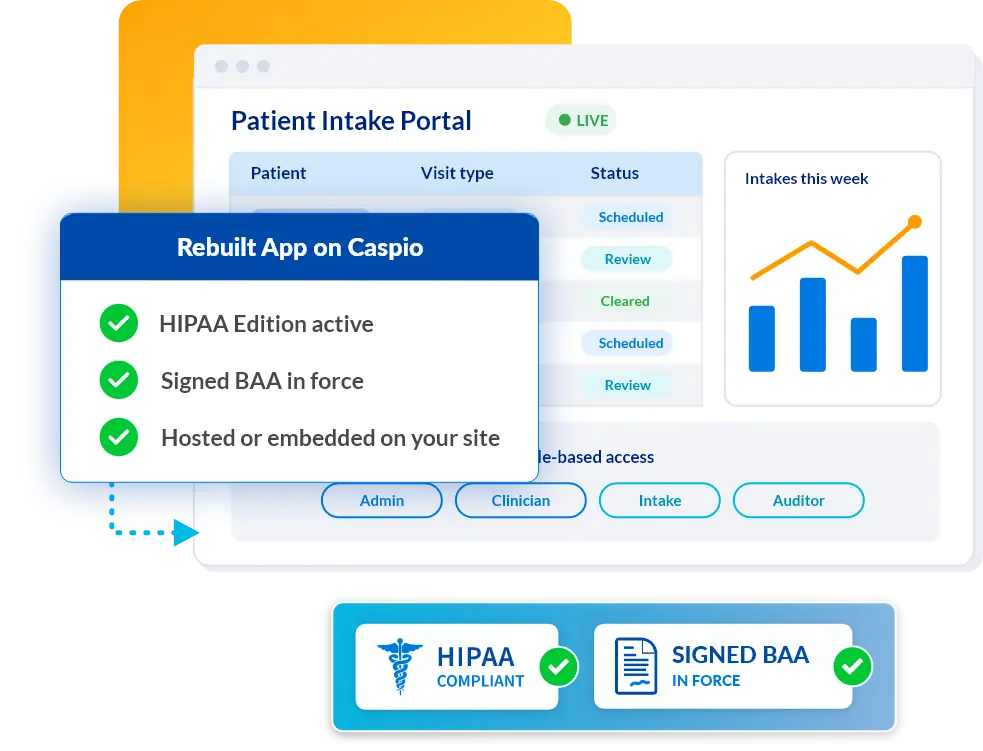
Caspio, an AI platform for building custom business applications, signs your BAA and runs the app in a compliant environment, with HIPAA-enabled deployment from $800/month total.
In short: Lovable proved the idea. Now the next decision is whether to retrofit, rebuild from scratch, or move the prototype into an environment where compliance is already built in. If you want a full side-by-side comparison instead, see our Lovable alternative comparison.
Because HIPAA compliance does not attach to an app. It attaches to every organization in the chain that touches protected health information: the application, the database, the hosting, and each vendor operating any of them. Under HIPAA, every one of those vendors is a business associate and must sign a BAA, a legal contract accepting responsibility for safeguarding PHI. No signed BAA at any layer, no compliant chain. This is a requirement of HIPAA compliance, not simply an internal policy preference.
Here is where that leaves a Lovable app. As of September 2026, Lovable publishes no BAA and no HIPAA offering on any plan, and its Terms of Service (updated August 28, 2026) prohibit protected health information on the platform unless a separate written agreement expressly permits it, an agreement it does not publicly offer. The same terms state that its standard services are “not designed to serve as a system of record for, or to provide regulatory-grade safeguards for, such data.”
To be fair to the tool you chose: Lovable is SOC 2 Type II and ISO 27001 certified, and those certifications are real (its SOC 2 report is shared for enterprise review under NDA, the normal practice). But they cover Lovable’s own service, not the app it generated for you, and neither one is a BAA. The wall you hit is structural, not a quality failure.

The structure gets one layer trickier, because a Lovable app is not one vendor. It is a stack:
So even the best-case retrofit leaves you assembling paper from multiple vendors to cover one small app, with at least one layer that publishes no paper at all. The same wall exists for apps built in Replit, Bolt.new, and Base44. It is the defining gap of vibe coding as a category: generation is instant, accountability is not included.

This is a real path, and for a team with security engineering capacity it can work. It looks like this:
Identify the frontend, hosting, database, auth, storage, edge functions, email, logging, and every third-party call the generated code makes.
For the database, that means moving to your own Supabase organization on a Team plan or above and buying its HIPAA add-on. For the Lovable-operated layers, no published BAA exists, so you re-host the frontend and rebuild what depended on the platform.
Lovable's own security guidance for founders is explicit that row-level security policies, scanning, secrets management, and penetration testing are your job: "you still need to verify that your policies are correct."
Put access controls, audit logging, encryption posture, breach procedures, and documentation in place so your auditor can review them.
Maintain the compliance chain through every dependency update, regenerated migration, and vendor terms change.
Step 3 is not hypothetical. CVE-2025-48757, published May 29, 2025, documented insufficient row-level security across Lovable-generated apps: of 1,645 apps scanned, 170 had databases exposed to unauthenticated reads and writes, leaking names, emails, financial data, and API keys. That is roughly one app in ten, built by people who believed they were done. Retrofitting means validating that your application’s security policies are configured correctly and remain correct after future changes. The stakes are asymmetric, which is why compliance officers stop projects. Industry research puts the cost of non-compliance at 2.65 times the cost of compliance (Ponemon), the average healthcare breach at $6.64 million (IBM, 2026), and OCR penalties at up to $2,190,294 per violation category per year. Budget the retrofit in weeks of skilled work, and plan for ongoing maintenance and compliance oversight.
A competent development team takes your prototype, treats it as the requirements document it genuinely is, and rebuilds it as custom software on infrastructure they select for HIPAA from the start.
Be clear about what changes: your prototype now carries a custom-software budget and a custom-software timeline, with discovery, build, security review, and deployment measured in months. And the compliance chain is still yours to assemble and maintain. The developers write the code; the BAAs with each hosting and service vendor, the audit posture, the monitoring, and every future update remain your responsibility, or become a retainer.
If you have genuinely custom requirements that no platform serves, this is the right road. Many prototypes do not require that level of custom engineering. They are forms, records, roles, dashboards, and workflow, the exact type of application platforms are built to operate.
The third option inverts the problem. Instead of dragging compliance to where your prototype lives, you bring your prototype to where compliance already exists.Caspio is an AI platform for building custom business applications, with more than two decades of platform engineering behind it. HIPAA, SOC 2 Type II, and GDPR are independently certified annually, and the certification covers the environment your app actually runs in: the platform, the SQL Server data core, the hosting. That is the meaning of the phrase we use deliberately: Caspio delivers a compliant app in a compliant environment. Your HIPAA contracting process is simplified to a single customer agreement with Caspio through the HIPAA Edition.
See how the full compliance posture is documented and verified. And here is the reframe that matters most: your Lovable prototype is not wasted work. It is the best requirements document you have ever produced. Every screen, field, role, and workflow decision is already made and demonstrated. Caspi, Caspio's AI app builder, builds applications from a description, and you are now the rare builder who has the complete description: your prototype's screens and data model become the spec you build from. The prototype becomes a working specification that can accelerate the rebuild process. AI is not the tradeoff you give up to get compliance. Caspio's AI capabilities run inside the certified environment:

The AI app builder that turns your description, your prototype's spec, into a working application.
MEET CASPI
A configurable chat capability inside your app for your end users, governed by role and field-level security.
SEE HOW CHAT AI AGENT WORKS
For OpenAI GPT, Google Gemini, and Anthropic Claude, with more on the way, so your app's workflows can call leading AI models.
DISCOVER AI EXTENSIONSCaspio's HIPAA-eligible AI features operate under signed BAAs. The AI providers behind these extensions are covered under Caspio's signed BAAs. That is the paper your compliance officer has been asking for. The same platform also serves organizations outside regulated industries that value security, reliability, and scalability. Healthcare teams get the compliant chain; everyone gets the same engineering.
We will not pretend this is one click. There is no magic importer that swallows a React codebase and emits a compliant application, from us or anyone. Here is the honest shape of the work, the same four workstreams every rebuild follows:

Take stock of what you can bring. Your Lovable code syncs to GitHub on every plan, which preserves the full specification. If your backend is your own Supabase project, your schema and data export with standard Postgres tooling. If it runs on Lovable Cloud, the data layer is operated by Lovable, so confirm your export options with them before planning the move. Either way, the model itself, tables, fields, relationships, is rebuilt on Caspio's SQL Server data core, and existing data imports from standard formats like CSV and Excel.
Your prototype's screens are rebuilt as complete Caspio-hosted apps or embeddable components, deployable on your own site under your own domain. This is where the prototype-as-spec advantage pays off: nobody debates what the intake form should look like, because everyone has already used it.
What Lovable left to machine-generated row-level security policies you were told to verify yourself, you configure here instead: role-based access, record-level permissions, field-level rules, set in the platform, not coded and re-audited.
Test against the prototype (your acceptance criteria already exist, you built them), activate the HIPAA Edition so the BAA and safeguards are in force, and publish.
A focused single-purpose app, a few tables and forms, typically takes days. A multi-role application with dashboards, workflows, and record-level permissions typically runs a week or two. Complex builds with integrations take longer, but you do not have to do it alone either.
Published numbers, because you should be able to budget this before you talk to anyone. Caspio plans start from $300/month. HIPAA is a $500/month add-on on top of your plan rate (one-year term). That puts a HIPAA-enabled deployment from $800/month total (TEAM plan plus the add-on). Full details on the pricing page and the HIPAA Edition page.
Compare that cost with your other two options. Option 1 costs weeks of skilled security work up front, then permanent ownership of a multi-vendor compliance chain and whatever a failure costs. Option 2 costs a custom-software engagement, with the chain still yours to maintain. Option 3 is a subscription with the compliance already inside it, and the reasons teams choose it go beyond the compliance alone. There is no free plan; every plan starts with a free 14-day trial, which is enough to rebuild a first table and form from your spec and see the path for yourself.
As of September 2026, Lovable publishes no BAA and no HIPAA offering on any plan, and its Terms of Service prohibit protected health information on the platform unless a separate written agreement expressly permits it, which it does not publicly offer. Lovable is SOC 2 Type II and ISO 27001 certified, but those certifications cover its own service, not HIPAA obligations for your app.
Yes, through a retrofit: move the database to a vendor that signs a BAA (for example, your own Supabase organization on an eligible paid plan with its HIPAA add-on), re-host the layers with no BAA path, audit the generated security policies, and implement access controls and audit logging. It is weeks of skilled work that you then own permanently through every change.
There is no one-click importer, from Caspio or anyone. Your prototype serves as the specification: your data imports from standard formats like CSV and Excel into Caspio’s SQL Server data core, and your screens are rebuilt as fully hosted standalone apps or embeddable components using the prototype as the agreed design. Caspi, Caspio’s AI app builder, builds from exactly that kind of description.
It depends on complexity, and honest ranges matter: a focused single-purpose app typically takes days to a couple of weeks, while a multi-role application with dashboards, workflows, and record-level permissions typically runs several weeks. Caspio or one of its certified partners can build it for you.
Caspio plans start from $300/month, and HIPAA is a $500/month add-on on top of your plan rate (one-year term), so a HIPAA-enabled deployment starts from $800/month total. Pricing is published, so you can budget before you ever talk to sales.
No. Caspio does not offer a free plan. Every plan comes with a free 14-day trial, so you can start the rebuild from your prototype’s spec before you buy.
Your prototype already captured the requirements. Build on a platform with a signed BAA, certified compliance, and AI-powered app development.


© 2026 Caspio, Inc. Sunnyvale, California. All rights reserved.
